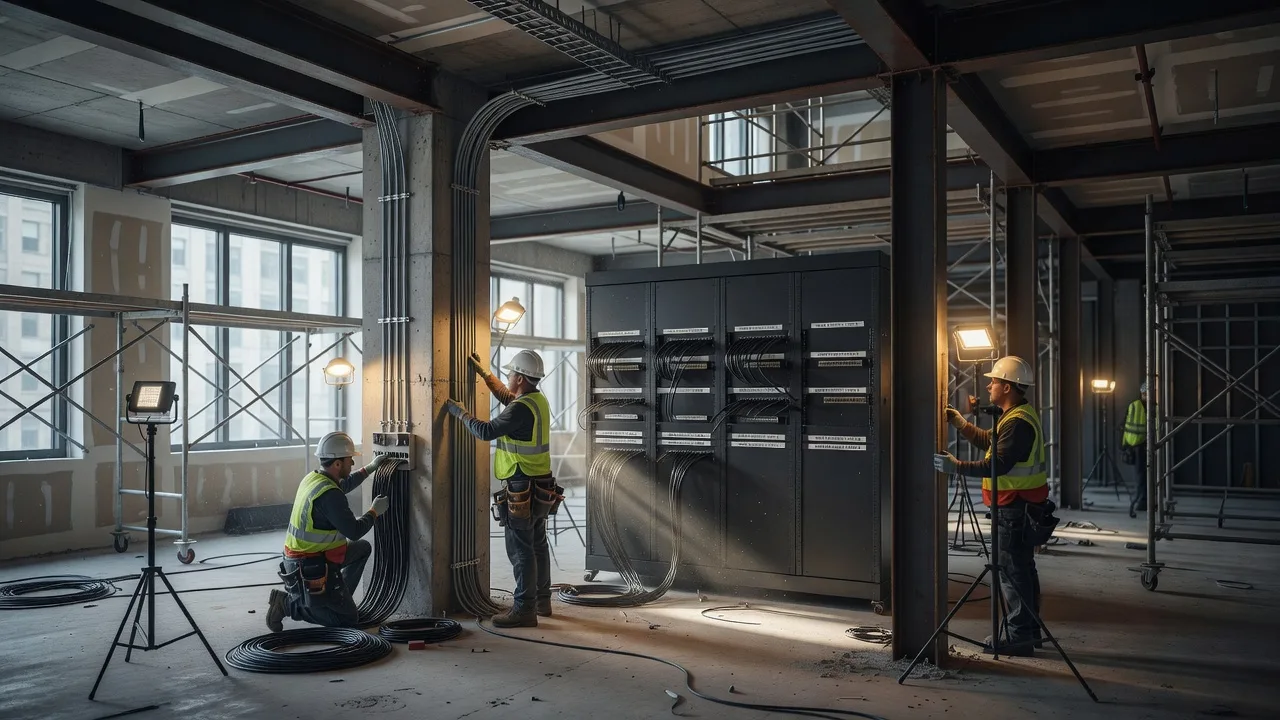
A commercial fiber optic cable installation needs a defined link, not just a cable length: endpoints, required speed, compatible optics, pathway, termination method and acceptance tests. Put those decisions in the bid before comparing prices. An MDF-to-IDF backbone and a campus connection may cover the same distance but involve different access, civil work and cutover responsibilities.
Low Voltage New York scopes commercial projects and matches them with partner contractors. Use the checklist below to prepare a fiber backbone installation in a New York office, school, warehouse or campus. If you already have drawings, tell us the endpoints, building location and required completion date: Get a Free Estimate.
Choose fiber and optics together
Single-mode and multimode are system choices. Record the switch and transceiver models at both ends, required speed, full link length and connector arrangement before specifying OS2, OM3, OM4 or OM5. Ask the designer to check the equipment manufacturer’s supported reach and optical loss budget for that exact combination.
For example, Cisco specifies up to 400 meters on OM4 for its SFP-10G-SR module. Its QSFP-40G-SR4 supports 150 meters on OM4 and uses a parallel-fiber connection. These are product-specific examples, not a universal distance limit for all 10G or 40G links. A fiber label alone does not establish that an upgrade will work. Cisco 10G data sheet; Cisco 40G data sheet.
For an existing plant, request its cable identification, strand map and test records before deciding what can be reused. For a new campus fiber installation, have the designer compare today’s equipment with the planned upgrade path and specify spare capacity deliberately. Neither distance nor future compatibility becomes unlimited by choosing single-mode.
Survey the route before pricing the pull
Separate the cable route from the straight-line distance between rooms. A survey should identify riser sleeves, available conduit, access panels, bends, pulling points, rack space and the people who control each work area. For an occupied New York building, confirm landlord access and permitted interruption windows before committing to a cutover date.
Pulling tension and bend radius depend on the cable product. Corning instructs installers to use the manufacturer’s limits and account for bends and pulling equipment; a generic diameter multiplier is not a substitute for the selected cable’s data sheet. Ask the bid to name the cable part number and installation procedure. Corning conduit-pulling guidance.
Cable jacket markings also matter. OFNP means nonconductive plenum; OFCP means conductive plenum. OFNR and OFCR are the corresponding nonconductive and conductive riser markings. Have the responsible designer or installer confirm the listing and installation method appropriate to each space under the applicable local requirements. Do not assume that an outdoor cable can continue through every interior space unchanged. Corning’s cable-marking definitions.
If a New York City route involves excavation or work that compromises the street surface, NYC DOT requires a Street Opening Permit. Treat that as a separate civil-work and coordination item; an internal riser pull is a different scope. Identify who owns permit applications, pathway access and restoration before comparing a building quote with an outside-plant quote. NYC DOT street-work requirements.
Make termination and testing deliverables explicit
Ask each bidder to identify the termination approach: fusion-spliced pigtails, a factory-terminated assembly or the specified field connector system. Record connector type, panels, splice trays, total terminated strands and spare strands. If an assembly is pre-terminated, the survey must allow for its connectorized end and pulling hardware along the proposed route.
Insertion-loss testing and OTDR testing answer different questions. An optical loss test set (OLTS), or the specified light source and power meter method, measures end-to-end loss. An optical time domain reflectometer (OTDR) characterizes events along the link, helping locate splice, connector and cable problems. Fluke describes Tier 2/extended OTDR measurements as a complement to Tier 1/basic testing, not a replacement. Fluke’s explanation of the two test levels.
Agree the test plan before installation: links and strands covered, wavelengths, directions, reference method, acceptance limits and whether OTDR traces are required by the project or warranty. Require reports that identify each link and its pass/fail result. “OTDR tested” without the agreed insertion-loss results does not document the complete acceptance plan.
A fiber bid checklist you can send to each bidder
Use the same scope fields for every proposal so omissions become visible:
- Endpoints and purpose: MDF/IDF or building names, existing system, required speed and the team approving equipment compatibility.
- Route and access: surveyed route length, available pathway, riser or campus conditions, room access and allowed working hours.
- Cable and capacity: manufacturer part number, fiber type, jacket listing, installed strand count and the strands to terminate now.
- Connection hardware: connector interfaces, panels, splice locations, patch cords and which party supplies the optics.
- Enabling work: new conduit, penetrations, firestopping, civil work and restoration, with responsibility assigned to a named party.
- Cutover: outage window, affected services, acceptance before migration and a rollback owner if the new link fails its checks.
- Closeout: labeled test reports, strand-to-port schedule, as-built route, splice records where applicable and editable or native test files if required.
- Commercial exclusions: permits, access escorts, after-hours work, equipment configuration and maintenance explicitly included or excluded.
Do not send network credentials or sensitive security-system drawings through a general enquiry form. An initial location, endpoint description and timing requirement are enough to start scoping; arrange appropriate handling for detailed plans afterward.
Compare the installed scope, not a per-foot headline
A bid for cable in an existing route should not be compared directly with a bid that includes new conduit, excavation, restoration and live-service migration. Break proposals into pathway work, cable supply and installation, termination hardware, testing and cutover. Ask which assumptions change the price after the site survey.
If your scope also includes copper outlets and new telecom closets, coordinate the fiber backbone with the structured cabling package. For a data hall, identify the panel, trunk and equipment-interface requirements with the data-center cabling scope, rather than assuming every connection uses the same fiber assembly.
Questions buyers ask before approving fiber work
Can we reuse the fiber already in the building?
Start with its identity, condition, length, connectors and test records, then compare them with the proposed optics and application limits. Include inspection and testing of candidate links in the survey scope; an illuminated port alone is not the acceptance record for the planned upgrade.
Do we need an OTDR report for every project?
Write that requirement into the specification when the design, warranty or troubleshooting need calls for it. Keep the agreed insertion-loss testing in the closeout package as well, and make the bidder state which measurements are included instead of using “certified” without a test definition.
What should we provide for an initial estimate?
Send the New York project location, the rooms or buildings being linked, whether the route exists, the required speed and your timing. Add known access or outage restrictions and identify the IT or facilities contact who can confirm the equipment and pathway details.
For commercial fiber optic cabling, LVNY can use that scope to match the project with an appropriate partner contractor. For a building in the city, the New York City project hub covers the broader commercial service paths. Get a Free Estimate for the fiber link you actually need installed.