OM3 AQUA · Division 27
Commercial Wi-Fi & Wireless Installation in New York
Wireless that's engineered, not sprinkled — surveys, AP installation, warehouse coverage and building-to-building links, delivered by licensed crews statewide.
- Predictive + on-site surveys
- AP installation and cabling
- Warehouse and industrial Wi-Fi
- Outdoor point-to-point links
- Wi-Fi 6E / 7 ready designs
- Vendor-agnostic deployment
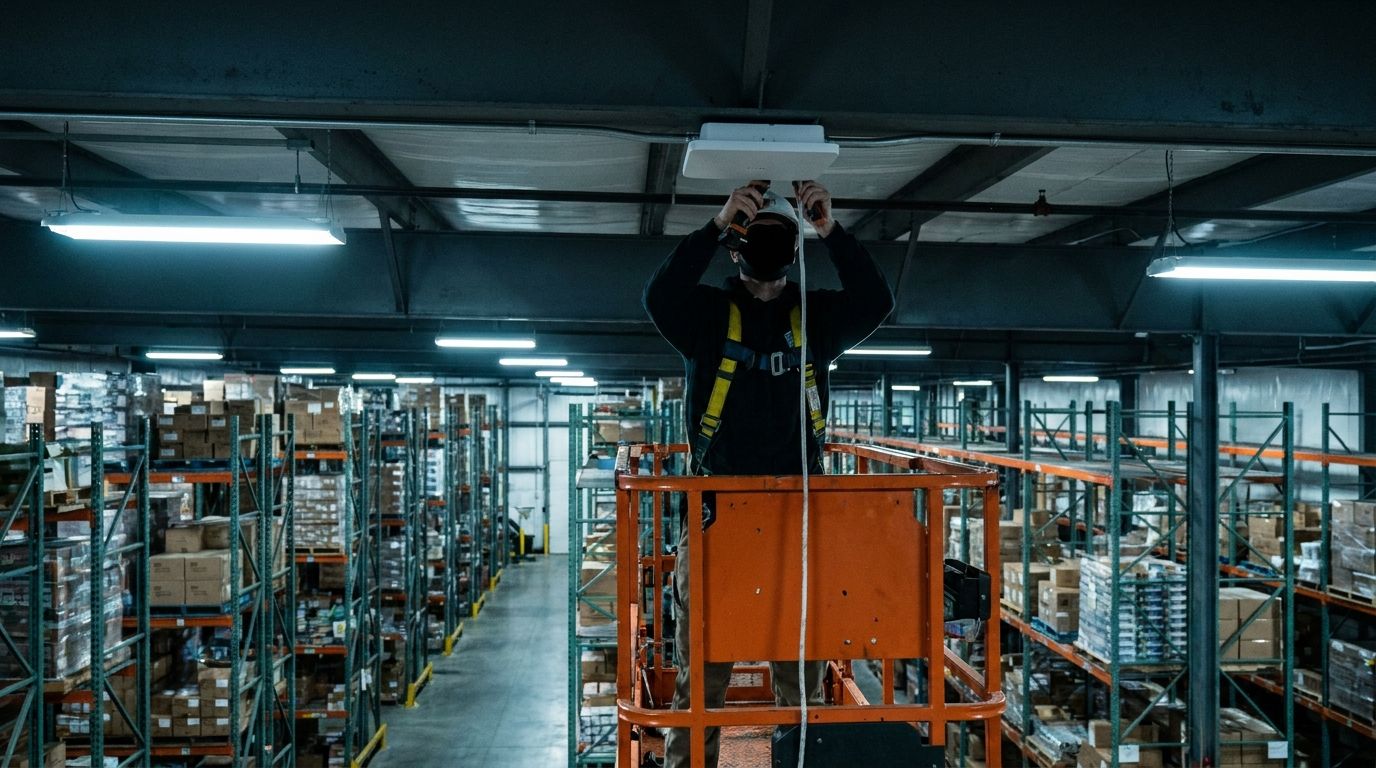
Bad Wi-Fi is rarely a hardware problem — it's a placement and design problem wearing a hardware costume. Access points bought by the dozen and mounted where the ceiling was convenient produce exactly the coverage map you'd expect: dead corners, co-channel interference in the middle, and a conference room that drops calls during every all-hands. Low Voltage New York scopes commercial wireless projects across the state and matches them with partner crews that treat RF as an engineering discipline — survey first, then mount.
The portfolio runs from carpeted office space to the hard cases: warehouses where racking turns every aisle into an RF canyon, manufacturing floors full of metal and motors, cold storage where physics gets weird, historic buildings where plaster-and-lath eats signal, and outdoor yards, campuses and parking structures. We also build point-to-point and point-to-multipoint wireless links between buildings — often the fastest and cheapest way to extend a network across a street, a yard or a campus when trenching fiber doesn't pencil.
We're vendor-agnostic across the major enterprise wireless platforms and work alongside your IT team's standards: they own the controller and the SSIDs, our crews own the survey, the cabling, the mounting and the validated coverage. If you don't have a platform preference, we'll recommend one proportionate to your environment rather than the most expensive one available.
Wireless surveys: predictive and on-site
Every serious wireless project starts with a survey. For new construction and standard offices, a predictive survey modeled from your floor plans — wall materials, ceiling heights, expected client density — produces an AP layout accurate enough to cable against. For complex environments and troubleshooting, an on-site survey with professional RF instrumentation measures what's actually in the air: existing coverage, interference sources, neighbor networks, and the specific attenuation your building's materials impose.
Post-install validation closes the loop. After deployment, crews re-walk the space and verify the delivered coverage against the design targets — signal strength, signal-to-noise ratio and roaming behavior — and you receive both the before and after heatmaps in closeout. Wireless is invisible; the documentation is what makes it accountable.
- Predictive design surveys from floor plans, for new builds and fit-outs
- On-site AP-on-a-stick surveys for warehouses, plants and problem buildings
- Spectrum analysis to find interference that isn't Wi-Fi at all
- Post-installation validation surveys with delivered heatmaps
Warehouse and industrial wireless
Warehouse Wi-Fi is its own specialty, and the failure mode is well known: coverage that looks fine in an empty building collapses when racking goes up and inventory fills in. Steel racking reflects and shadows RF, forklifts and scanners roam constantly and punish bad roaming design, and mounting heights of 30 feet and up change antenna selection entirely — often in favor of directional antennas aimed down aisles rather than omnidirectional pucks scattered on the deck.
Partner crews design for the loaded building, not the empty one, and install to industrial reality: sealed enclosures where wash-down or dust demands them, drop protection over forklift traffic, and cabling run in conduit or mesh where the environment would eat exposed cable. Cold storage, with its dense product and condensation-hostile electronics, gets equipment rated for the job.
Outdoor coverage and point-to-point links
Outdoor wireless splits into two disciplines. Coverage — yards, loading aprons, guest patios, campus quads, parking structures — uses ruggedized APs with proper mounting, grounding and lightning protection, engineered for the client devices that will actually roam there. Links — point-to-point and point-to-multipoint bridges between buildings — replace or defer fiber trenching, carrying hundreds of megabits to multiple gigabits across line-of-sight paths using 5 GHz, 60 GHz or licensed microwave depending on distance, throughput and reliability targets.
A well-built link is a legitimate piece of network infrastructure: path analysis before purchase, Fresnel zone clearance verified, mounts engineered for wind load, surge protection at both ends, and throughput tested and documented at handover. For campuses, yards with outbuildings, and offices across the street from their warehouse, it's frequently the highest-ROI item in the whole low-voltage budget.
Projects to include in your scope
- Office Wi-Fi design and refresh projects
- Warehouse and industrial coverage
- Building-to-building wireless links
- Outdoor and campus wireless coverage
Coverage
Commercial Wi-Fi & Wireless by region
FAQ
Commercial Wi-Fi & Wireless — Common Questions
How many access points does my space need?
There's no honest per-square-foot answer — AP count depends on construction materials, ceiling height, client density and what the network must do (email in an office and voice-roaming scanners in a warehouse are different designs). A predictive survey from your floor plans produces a defensible count in a few days, and it's usually fewer, better-placed APs than the rule-of-thumb number. We quote the survey and the install separately so the design stands on its own.
Do I really need a wireless survey, or can you just install APs?
For a small, conventional office, a predictive design from plans is often sufficient and we won't upsell an on-site survey you don't need. For warehouses, manufacturing, healthcare, cold storage or any building with a history of Wi-Fi complaints, measured on-site survey data pays for itself — it's the difference between engineering and guessing. Either way, no partner crew of ours mounts APs without a design document behind the layout.
Can you work with the wireless vendor our IT team already uses?
Yes — we're vendor-agnostic and deploy on all the major enterprise platforms. Your IT team typically retains control of the controller, SSIDs and security policy; our crews deliver the survey, the Cat6/Cat6A cabling to each AP location, physical mounting, and validated coverage against the design. If you'd rather we handle configuration end to end, partner crews can take that scope too — we fit the division of labor to your team.
Our warehouse has dead zones even though we have plenty of APs. Can that be fixed?
Almost always, and often without buying more hardware. The usual culprits are omnidirectional APs mounted too high, layouts that ignored racking, channel plans with self-interference, and roaming settings that let scanners cling to distant APs. An on-site survey diagnoses which of these you have; the fix is typically a mix of relocation, antenna changes and configuration, with new APs only where the design genuinely calls for them.
Is a point-to-point wireless link as good as running fiber between buildings?
For many links, functionally yes — modern 60 GHz and licensed microwave bridges deliver gigabit-class throughput with strong reliability, installed in days for a fraction of trenching cost. Fiber still wins where you need maximum capacity, decades of service life, or there's no clean line of sight. We'll price both honestly: when a path analysis shows a solid link and trenching quotes come back with a comma too many, the bridge is usually the right call.
Pricing a commercial wi-fi & wireless project?
Share your building location, scope and timing. We will match your commercial enquiry with the appropriate partner contractor.