AV PURPLE · Division 27
Commercial AV Installation Contractors in New York
Conference rooms that start meetings on time, video walls that impress in lobbies, paging that's intelligible in the warehouse — designed and installed statewide.
- Teams / Zoom conference rooms
- Video walls + digital signage
- Sound masking systems
- Paging and background audio
- DSP tuning + commissioning
- Multi-room standardization
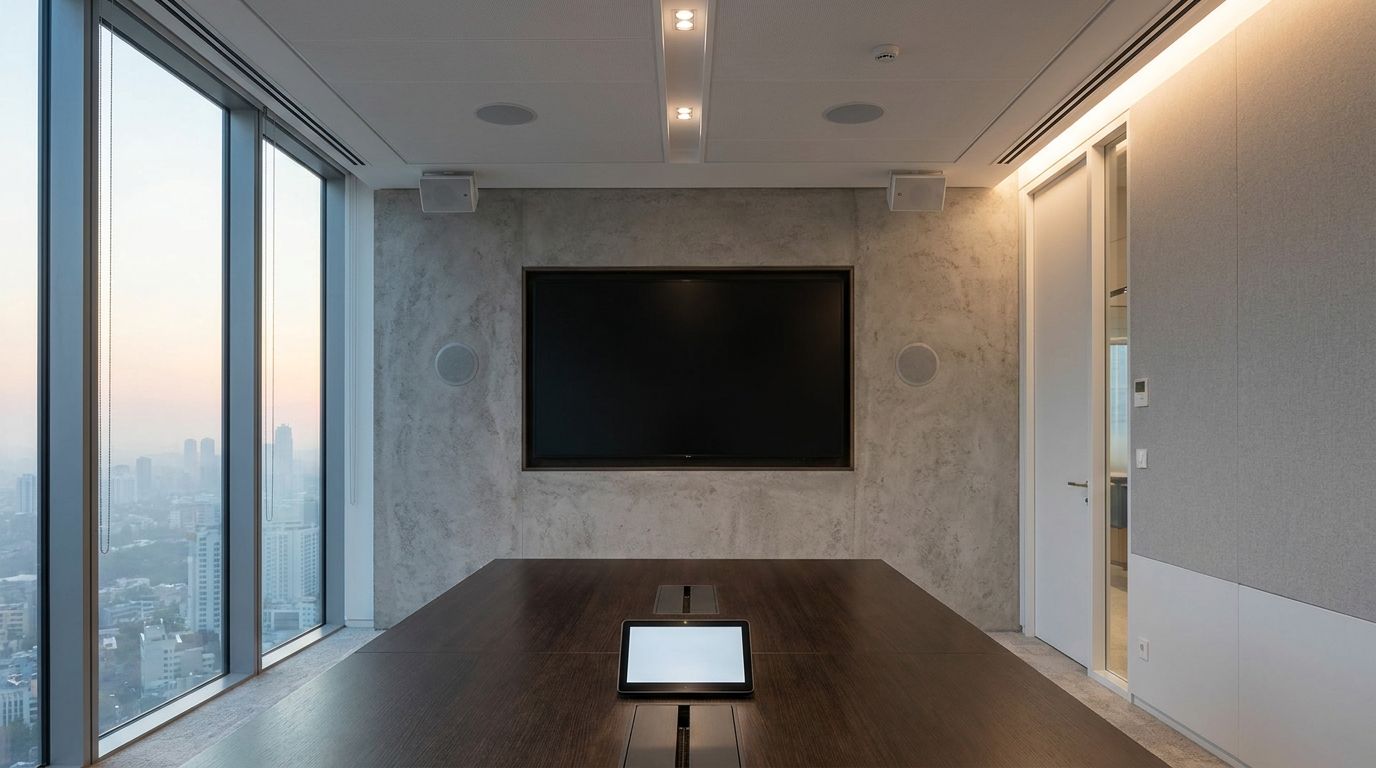
The test of commercial AV isn't the demo — it's the 9:00 a.m. meeting where a director taps one button and the far end can see and hear everyone within ten seconds. Systems fail that test when they're assembled from parts instead of designed as rooms: mismatched DSP settings, mics that pick up the HVAC, displays mounted for the installer's convenience rather than the sightlines. Low Voltage New York scopes commercial AV projects across the state and matches them with partner crews who design, install and — critically — commission systems until they behave.
The work spans the full commercial AV canon. Conference and huddle rooms built around Teams or Zoom, with ceiling or table mics, cameras framed for the actual seating, and one-touch join. Video walls and large-format displays for lobbies, command centers and trading floors. Digital signage networks with content management your marketing team can drive. Overhead paging that's intelligible in a 400,000-square-foot warehouse, background audio for retail and hospitality, and sound masking that makes open offices and medical suites speech-private.
Because AV rides on the network and lives in the ceiling, our cabling DNA is an advantage: the same project can include the Cat6A to every display, the containment-clean pathway, and the rack work — one scope, one schedule, one point of accountability.
Conference rooms and collaboration spaces
Room systems succeed on standardization. We design a small number of room types — huddle, medium conference, boardroom, training — and repeat them, so every room in your office works identically and your IT team supports one playbook instead of twelve science experiments. Builds are platform-native for Microsoft Teams Rooms or Zoom Rooms, with certified hardware, wired one-touch join, and audio DSP tuned to the room's real acoustics after furniture is in.
Boardrooms and training rooms get the added engineering they need: multiple camera positions with speaker tracking, program audio separate from voice lift, room combining where dividable spaces demand it, and control interfaces simple enough that nobody phones IT to start a meeting.
- Huddle rooms through boardrooms, standardized by room type
- Ceiling mic arrays, beamforming and acoustic echo cancellation done properly
- Scheduling panels, room booking and occupancy integration
- Cable-cleanliness details — floor boxes, table cubbies and raceway that survive daily use
Video walls and digital signage
Video walls are structural projects as much as display projects: wall loading, serviceable mounting systems, ventilation, power provisioning and pixel-pitch selection all precede the glamour. Partner crews install direct-view LED and tiled LCD walls for lobbies, security operations centers and showrooms, with the processing hardware to feed them and calibration so the array reads as one canvas rather than a grid of slightly different panels.
Signage networks are an operations design problem: displays are the easy part, while content scheduling, remote management and proof-of-play reporting determine whether the network is alive in a year. We install the endpoints and network them properly, and we'll integrate with the CMS platform your team chooses — or recommend one sized to your ambitions.
Paging, background audio and sound masking
Warehouse and industrial paging is an intelligibility engineering exercise — speaker selection, placement density and zoning have to defeat 30-foot ceilings, racking and machine noise, and integration with telephony or dispatch systems has to be seamless for the operators who page fifty times a shift. Retail and hospitality audio flips the priorities: even coverage at low levels, easy source control, and zones that let the café and the sales floor live different sonic lives.
Sound masking is the quiet specialty in the lineup: emitter arrays that raise the ambient floor just enough to make nearby conversations unintelligible, tuned zone by zone. It's become standard kit for open-plan offices, HR suites, law firms and medical spaces where speech privacy is either a comfort issue or a compliance one.
Projects to include in your scope
- Office-wide conference room programs
- Lobby video walls and signage networks
- Warehouse paging and mass notification
- Sound masking for open offices and medical suites
Coverage
Commercial AV Installation by region
FAQ
Commercial AV Installation — Common Questions
What does a conference room AV build cost?
Room class drives it: a huddle room with a certified video bar is the entry point; a medium room adds ceiling mics, a dedicated camera and room control; boardrooms with speaker tracking, multiple displays and voice lift are an order of magnitude beyond the huddle space. Standardizing room types across an office lowers per-room cost and support burden meaningfully. We quote per room type with equipment itemized, so scaling the program up or down is arithmetic.
Can you standardize AV across our offices in different cities?
Yes — that's precisely where a statewide network beats a single local integrator. We document your room standards once, then partner crews in each metro build to the same specification, with the same commissioning checklist and closeout package. Your IT team gets identical rooms in Manhattan and Rochester, and rollouts run in parallel instead of waiting on one crew's travel schedule.
Who handles the programming and DSP tuning?
The installing crew does — commissioning is part of the scope, not a separate contract. That covers DSP configuration and echo-cancellation tuning after furniture is in, control system programming, platform enrollment for Teams or Zoom Rooms, and a punch-list session with your IT team in the actual rooms. A system that's installed but not commissioned is the most common AV failure mode in commercial buildings, and we don't hand those over.
What are typical lead times for commercial AV projects?
Design and quoting move in days, but equipment sets the pace: standard conferencing hardware is usually available quickly, while direct-view LED walls, custom mounts and some DSP hardware can carry lead times of several weeks to a few months depending on the product and market. For construction-tied projects we sequence rough-in early so long-lead equipment lands into a ready room. Give us your target occupancy date and we'll build the schedule backward from it.
Do you coordinate with our GC and furniture vendor during construction?
Yes, and the project goes better when we're involved before drywall. AV needs blocking in walls for displays, conduit and floor boxes where tables will sit, power at mounting positions, and ceiling coordination with lighting and HVAC — all cheap during rough-in and expensive after. We attend coordination meetings, issue rough-in drawings, and time final install after paint and furniture so commissioning happens in the room as it will actually be used.
Pricing a commercial av installation project?
Share your building location, scope and timing. We will match your commercial enquiry with the appropriate partner contractor.