PLENUM BLACK · Division 28
Commercial CCTV & Security Camera Installation in New York
IP camera systems designed for businesses — offices, warehouses, retail, multifamily and campuses. Engineered coverage, real retention math, monitoring-ready. Commercial properties only.
- IP cameras, PoE-powered
- VMS and NVR platforms
- Retention-based storage sizing
- Remote monitoring readiness
- Coax-to-IP takeovers
- Commercial properties only
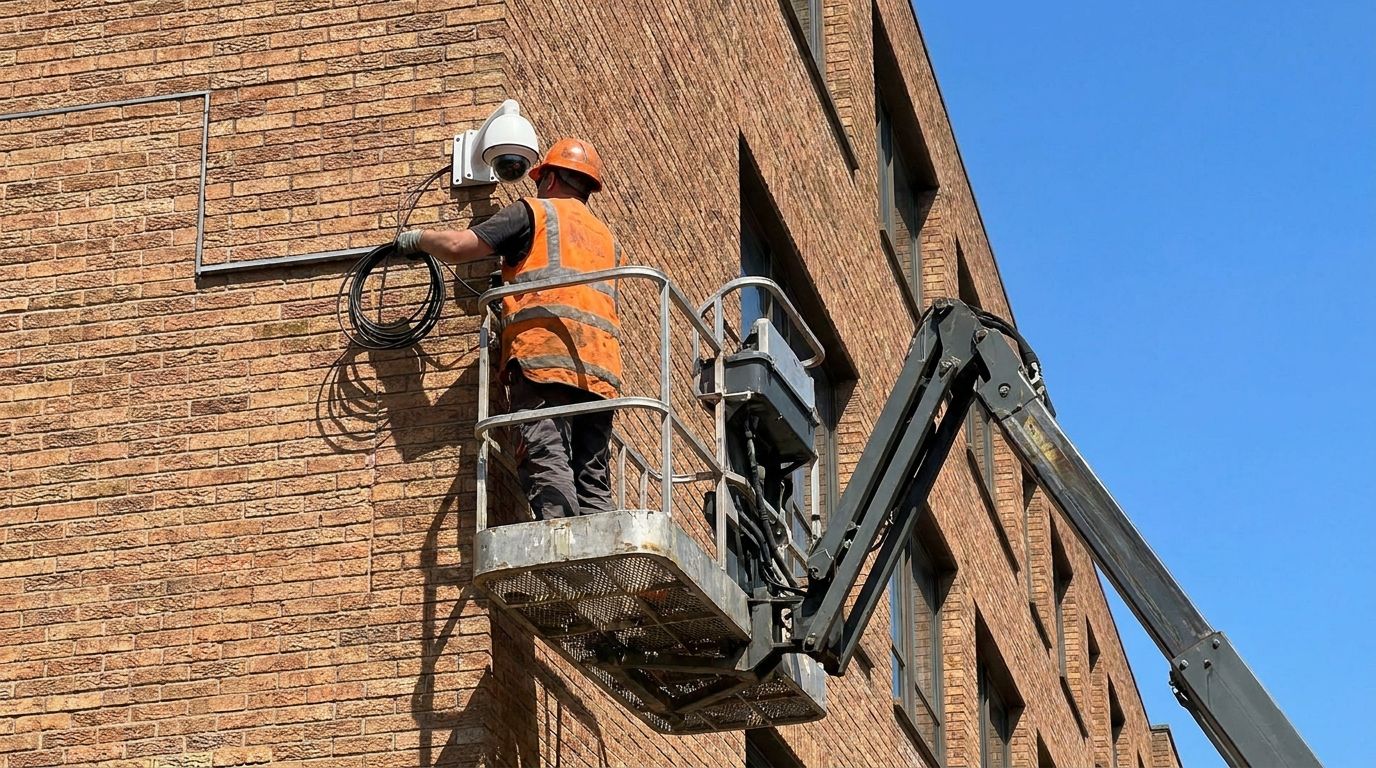
One thing up front: we install camera systems for commercial properties — offices, warehouses, retail, industrial sites, campuses, and the common areas of multifamily buildings. We don't do homes, and we won't quote residential doorbell setups. If you manage or own a business property in New York State, read on.
A commercial video system earns its budget on three things: camera placement that actually captures usable detail, a video management system your staff will genuinely use, and retention sized to survive the gap between an incident and its discovery — which in commercial disputes is often weeks, not hours. Low Voltage New York scopes camera projects from your floor plans or a site walk, then matches the work with licensed partner crews who design and install IP systems as their trade, not as an add-on to alarm sales.
Deployments are PoE end to end: cameras powered over the same Cat6 that carries their video, home-run to switches and recorders in your telecom rooms, with no wall-wart power supplies hidden above ceiling tiles. We're vendor-flexible on cameras and VMS platforms, and we design for where you're going — if third-party remote video monitoring is on your roadmap, the system gets built monitoring-ready from day one.
System design: CCTV and IP camera coverage that holds up
Camera counts don't equal coverage. A design pass walks your property against the incidents you're actually trying to resolve — vehicle damage claims, dock disputes, slip-and-fall defense, after-hours entry — and places cameras for identification where it matters and situational awareness everywhere else. Pixel density, mounting height, lighting conditions and lens choice all get engineered, because a camera that captures a hooded silhouette at 40 feet resolves nothing and costs the same to install as one that works.
Exterior work gets the same rigor: appropriate housings for New York winters, corrosion-resistant mounting, conduit where cable is exposed, and surge protection on runs that leave the building envelope.
- Fixed dome, bullet, turret and multi-sensor panoramic cameras, matched to each view
- License plate capture at gates and drive lanes, engineered as its own use case
- Low-light and IR planning for lots, docks and perimeters
- PoE infrastructure — switching, cabling and midspans sized with power budget headroom
VMS, NVR and storage architecture for business security cameras
Recording architecture is a fit decision. Purpose-built NVR appliances suit single sites that want simplicity; server-based or cloud-connected VMS platforms suit multi-site portfolios, integrations and analytics. The line item most often undersized is storage: retention is a function of camera count, resolution, frame rate, compression and motion profile, and we run that math explicitly instead of guessing. If you need 30, 60 or 90 days of retention for insurance or compliance reasons, the estimate shows the disk that actually delivers it.
Analytics are worth having when they solve a named problem — line-crossing alerts on a perimeter, people counting at retail entries, camera-tamper alarms on vulnerable mounts. We'll configure what you'll use and skip the demo-reel features you won't.
Remote monitoring readiness
More New York businesses are pairing cameras with off-site live monitoring — a service where a monitoring center watches events after hours and can trigger audio warnings or dispatch. Whether or not you subscribe today, we build so you can: reliable outbound bandwidth from the recorder, cameras and VMS chosen for event-based alerting, health monitoring so a dead camera gets noticed before it's needed, and clean handoff documentation for whichever monitoring provider you select.
For your own team, remote access is table stakes — secure mobile and desktop viewing, per-user permissions so the warehouse lead sees the docks and not the executive floor, and audit trails on who viewed and exported what.
Commercial proof standards (not residential camera kits)
Local winners on commercial camera search results share a pattern: they talk like integrators who live in warehouses and multi-tenant buildings, not like doorbell installers. Our partner crews work the same proof stack — coverage maps tied to real incidents (dock disputes, lot damage, after-hours entry), PoE infrastructure sized with power budget headroom, retention math written into the estimate, and NDAA Section 889-aware camera selection when the owner, GC, or public funding requires it.
Licensing is non-negotiable on alarm and security systems work in New York: installers need the appropriate state Security or Fire Alarm Installer credential (GBL Article 6-D) layered on local electrical/low-voltage rules. We only match camera projects to licensed, insured commercial crews. If a quote skips site survey, storage sizing, or cabling pathway, it is not a commercial design — it is a parts list.
- Commercial properties only — offices, warehouses, retail, industrial, multifamily common areas
- Coverage design for identification where it matters, situational awareness elsewhere
- NDAA-aware options for government-adjacent and critical infrastructure owners
- State-licensed security system installers, not residential alarm sidelines
- Monitoring-ready outbound, health alerts, and clean handoff docs for remote centers
Cost ranges and how camera quotes are built
Commercial installed pricing is a system number, not a camera SKU. Per-position cost moves with camera class, mounting height, outdoor exposure, and cable distance back to the IDF; recorder, VMS licensing, switching, and retention disk amortize across the count. Our security camera installation cost guide publishes the ranges facilities managers actually see in New York — including why consumer 'per camera' averages are the wrong benchmark for a warehouse or multi-tenant stack.
Send floor plans or schedule a walk. We return a camera schedule with per-position line items so you can phase docks before offices, or exterior before interior, without re-bidding the whole site. Free estimates within about 48 hours of a complete scope package.
Projects to include in your scope
- Warehouse and logistics camera systems
- Office and multi-tenant building coverage
- Retail and QSR multi-site rollouts
- Analog-to-IP system upgrades
Related
Guides, codes & local pages
Security camera installation cost in NY
Per-camera and full-system ranges, cloud vs NVR
Access control systems
Doors, credentials and video call-up integration
Access control cost guide
Per-door tiers and NYC egress hardware rules
Structured cabling cost (PoE drops)
Why each camera is also a data drop
Cameras in New York City
Borough commercial stock and multi-tenant realities
Cameras on Long Island
Warehouses, docks and industrial park coverage
Coverage
Commercial Security Cameras by region
New York City
Cameras in Manhattan, Brooklyn, Queens, Bronx & nearby
Long Island
Cameras in Hempstead, Melville, Hauppauge, Farmingdale & nearby
Western New York
Cameras in Buffalo, Rochester, Niagara Falls, Amherst & nearby
Capital Region
Cameras in Albany, Schenectady, Troy, Saratoga Springs & nearby
FAQ
Commercial Security Cameras — Common Questions
What's the difference between CCTV and IP camera systems?
CCTV (Closed-Circuit Television) traditionally refers to analog camera systems that transmit video over coaxial cable to a DVR. IP cameras are network devices that transmit digital video over Ethernet (Cat6) to an NVR or VMS server. In practice, the term 'CCTV' is now used loosely to describe all video surveillance systems, including modern IP-based ones. For new installations in New York commercial buildings, IP cameras are the standard: higher resolution (4MP-8MP vs. analog's 960H), Power-over-Ethernet (one cable for power and data), scalable storage, remote access, and AI analytics. We install IP camera systems exclusively for new deployments, but can integrate or migrate existing coax-based CCTV.
How many cameras does a typical business need?
Camera count depends on building size, layout, risk profile and coverage goals. A small office (2,000-5,000 sq ft) typically needs 4-8 cameras covering entrances, exits, and high-value areas. A warehouse (10,000-50,000 sq ft) may need 12-24 cameras for perimeter, loading docks, aisles, and common areas. Retail locations prioritize POS coverage and entrance/exit. We design coverage maps during the site survey — placing cameras to eliminate blind spots while minimizing camera count. Over-cameraing is a common waste; the right lens selection and placement often achieves better coverage with fewer cameras.
What does a commercial camera system cost per camera?
Installed per-camera cost depends on camera class (a multi-sensor panoramic costs several times a fixed turret), mounting conditions (a 30-foot warehouse ceiling or a parking lot pole is a different install than an office soffit), and cable run lengths. System-level costs — recorder, VMS licensing, switching, storage — amortize across the count. We quote from a camera schedule with per-position line items so you can trim or phase intelligently.
How many days of video retention do I need, and what does it take?
Most commercial sites land between 30 and 90 days; the driver is how late incidents surface — injury claims and inventory discrepancies often appear weeks after the fact, and insurers or attorneys may request specific windows. Storage needs scale with camera count, resolution, frame rate and motion levels, so doubling retention doesn't always mean doubling disk. We size storage to your stated retention with documented assumptions, and it's expandable later.
Can you reuse my existing analog cameras or coax cabling?
Sometimes, and we'll tell you when it's worth it. Existing coax can carry HD video via HD-over-coax cameras or be repurposed with Ethernet-over-coax converters, which saves re-cabling costs in hard-to-wire buildings. But converter hardware, PoE limitations and image quality caps mean full IP on new Cat6 usually wins where pathways are accessible. The site survey settles it with numbers rather than ideology.
Are there legal restrictions on where I can point cameras at my business?
Yes — placement carries real legal boundaries. Cameras don't belong anywhere with a reasonable expectation of privacy (restrooms, locker rooms), audio recording is regulated separately and more strictly than video, and workplaces and multifamily common areas each raise their own considerations. We install to accepted commercial practice and flag placements that raise questions, but for policy decisions — employee notification, signage, retention policies — your attorney gets the final word.
Do you install home security cameras?
No. Low Voltage New York serves commercial properties only — offices, warehouses, retail, industrial, campuses and the common areas of multifamily buildings. Residential driveways, doorbells and single-family homes are outside our network's scope, and honestly, consumer platforms serve that market well. If you're a property manager for an apartment building, that's commercial work and we'd be glad to scope it.
How do I find reliable security camera installation companies near me?
Searching 'security camera installation companies near me' returns dozens of results, but many are alarm companies that do cameras as a sideline — a very different trade from a dedicated low-voltage integrator who designs and installs IP camera systems every week. For commercial work in New York, look for BICSI training or manufacturer certifications from NDAA-compliant brands like Axis, Hanwha, Bosch or Pelco (NDAA compliance matters if you do any government or critical-infrastructure work), and verify commercial liability insurance — not just a residential alarm license. Low Voltage New York pre-vets licensed security camera installation companies across every NY region, so you get a crew that does commercial camera work as its core trade.
Do commercial security cameras in New York require a licensed installer?
Security and fire alarm system installation in New York is regulated under General Business Law Article 6-D. Commercial camera projects that are part of a security system should be installed by appropriately licensed firms — not an unlicensed handyman pulling PoE as a favor. Partner crews in our network carry the licenses required for the jurisdictions they serve; we confirm fit during scoping.
What does NDAA compliance mean for business security cameras?
NDAA Section 889 restricts certain telecommunications and video surveillance equipment from named manufacturers on federal and many government-adjacent projects. Even private owners increasingly specify NDAA-compliant cameras to keep future tenants, insurers, or public funding options open. We design with NDAA-aware options when the project requires it and will flag the cost delta honestly.
Pricing a commercial security cameras project?
Share your building location, scope and timing. We will match your commercial enquiry with the appropriate partner contractor.