PLENUM BLACK · Division 28 · Long Island
Commercial Security Camera Installers on Long Island
Serving Hempstead, Melville, Hauppauge, Farmingdale, Garden City and every commercial corridor in Long Island.
- IP cameras, PoE-powered
- VMS and NVR platforms
- Retention-based storage sizing
- Remote monitoring readiness
- Coax-to-IP takeovers
- Commercial properties only
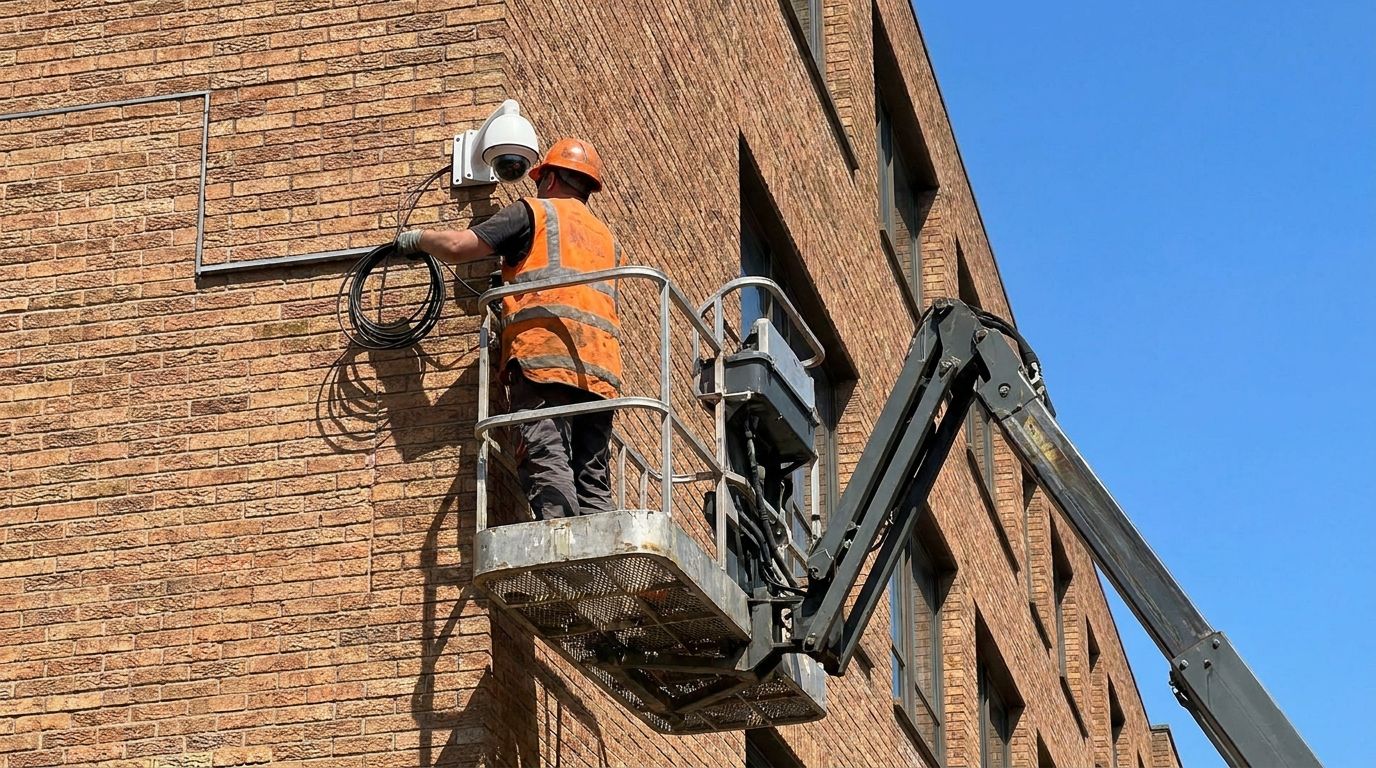
The Long Island camera project has a recognizable shape: a standalone commercial building with a parking lot, dock doors and a perimeter that goes dark at 6 p.m. Coverage design starts outside — lot entrances, building corners, dock aprons — with cameras and illumination chosen for actual overnight performance, then works inward to lobbies, cash-handling areas and stock rooms. Our Nassau and Suffolk crews walk the property line before they spec a single camera.
Industrial and distribution users dominate the demand, especially across the Hauppauge park and the warehouse clusters near the LIE interchanges, where shrink at the dock and after-hours lot activity are the problems footage has to solve. But the Island's retail strips, medical offices and auto-related businesses generate steady work too — each with different retention needs, different mounting environments, and different answers on whether the NVR lives on-site or the footage rides to the cloud.
Commercial Security Cameras where you are
Dock operations are where Long Island camera systems earn their money. Distributors and light manufacturers across Suffolk's industrial parks need seamless coverage of every trailer position, driver check-in and staging lane — footage that resolves shortage claims, backs up incident reports and occasionally settles a dispute with a carrier in one email. Our crews design dock coverage from the yard's actual traffic pattern, not from a satellite photo. Retail is the other Long Island camera pattern: commercial security camera installation for Northport Village storefronts and East Northport plazas covers entries, POS and lots without a warehouse-yard template.
Commercial locations in this region include Hauppauge industrial area, Route 110 corridor: Melville and Farmingdale, Garden City and Mineola office areas. Confirm the site address, building access and contractor availability when planning the schedule.
What the work includes
Camera counts don't equal coverage. A design pass walks your property against the incidents you're actually trying to resolve — vehicle damage claims, dock disputes, slip-and-fall defense, after-hours entry — and places cameras for identification where it matters and situational awareness everywhere else. Pixel density, mounting height, lighting conditions and lens choice all get engineered, because a camera that captures a hooded silhouette at 40 feet resolves nothing and costs the same to install as one that works.
Exterior work gets the same rigor: appropriate housings for New York winters, corrosion-resistant mounting, conduit where cable is exposed, and surge protection on runs that leave the building envelope.
- Fixed dome, bullet, turret and multi-sensor panoramic cameras, matched to each view
- License plate capture at gates and drive lanes, engineered as its own use case
- Low-light and IR planning for lots, docks and perimeters
- PoE infrastructure — switching, cabling and midspans sized with power budget headroom
Related
More in Long Island
All services in Long Island
Every low voltage trade we cover in the region
Commercial Security Cameras statewide
Full scope, standards, and FAQs for this service
Get a Free Estimate
Share the building, scope and target date
Security camera installation cost in NY
Per-camera and full-system ranges, cloud vs NVR
Access control systems
Doors, credentials and video call-up integration
Access control cost guide
Per-door tiers and NYC egress hardware rules
FAQ
Commercial Security Cameras in Long Island — Questions
Can cameras cover our warehouse yard and dock doors at night?
Yes, if they're specified for it — that means low-light or IR-capable cameras positioned per dock zone, attention to backlight from yard fixtures, and lens choices that keep trailer numbers readable at distance. Overnight yard coverage is a design requirement we test at commissioning, not an assumption.
Do we need permits or approvals to put cameras on our own commercial building on Long Island?
On your own property, camera placement is generally your call, though exterior electrical work and signage rules vary by town and any landlord or park association standards still apply. We flag anything requiring town-level attention during the site walkthrough so nothing surfaces after installation.
What's the difference between CCTV and IP camera systems?
CCTV (Closed-Circuit Television) traditionally refers to analog camera systems that transmit video over coaxial cable to a DVR. IP cameras are network devices that transmit digital video over Ethernet (Cat6) to an NVR or VMS server. In practice, the term 'CCTV' is now used loosely to describe all video surveillance systems, including modern IP-based ones. For new installations in New York commercial buildings, IP cameras are the standard: higher resolution (4MP-8MP vs. analog's 960H), Power-over-Ethernet (one cable for power and data), scalable storage, remote access, and AI analytics. We install IP camera systems exclusively for new deployments, but can integrate or migrate existing coax-based CCTV.
How many cameras does a typical business need?
Camera count depends on building size, layout, risk profile and coverage goals. A small office (2,000-5,000 sq ft) typically needs 4-8 cameras covering entrances, exits, and high-value areas. A warehouse (10,000-50,000 sq ft) may need 12-24 cameras for perimeter, loading docks, aisles, and common areas. Retail locations prioritize POS coverage and entrance/exit. We design coverage maps during the site survey — placing cameras to eliminate blind spots while minimizing camera count. Over-cameraing is a common waste; the right lens selection and placement often achieves better coverage with fewer cameras.
Need cameras in Long Island?
Share your building location, scope and timing. We will match your commercial enquiry with the appropriate partner contractor.