PLENUM BLACK · Division 28
Commercial Access Control System Installation in New York
Card readers, mobile credentials, electrified hardware and intercoms — designed around how your building actually operates, installed by licensed Division 28 crews.
- Card readers + mobile credentials
- Electrified door hardware
- Video intercoms
- Multi-tenant systems
- Cloud and on-prem platforms
- Elevator access integration
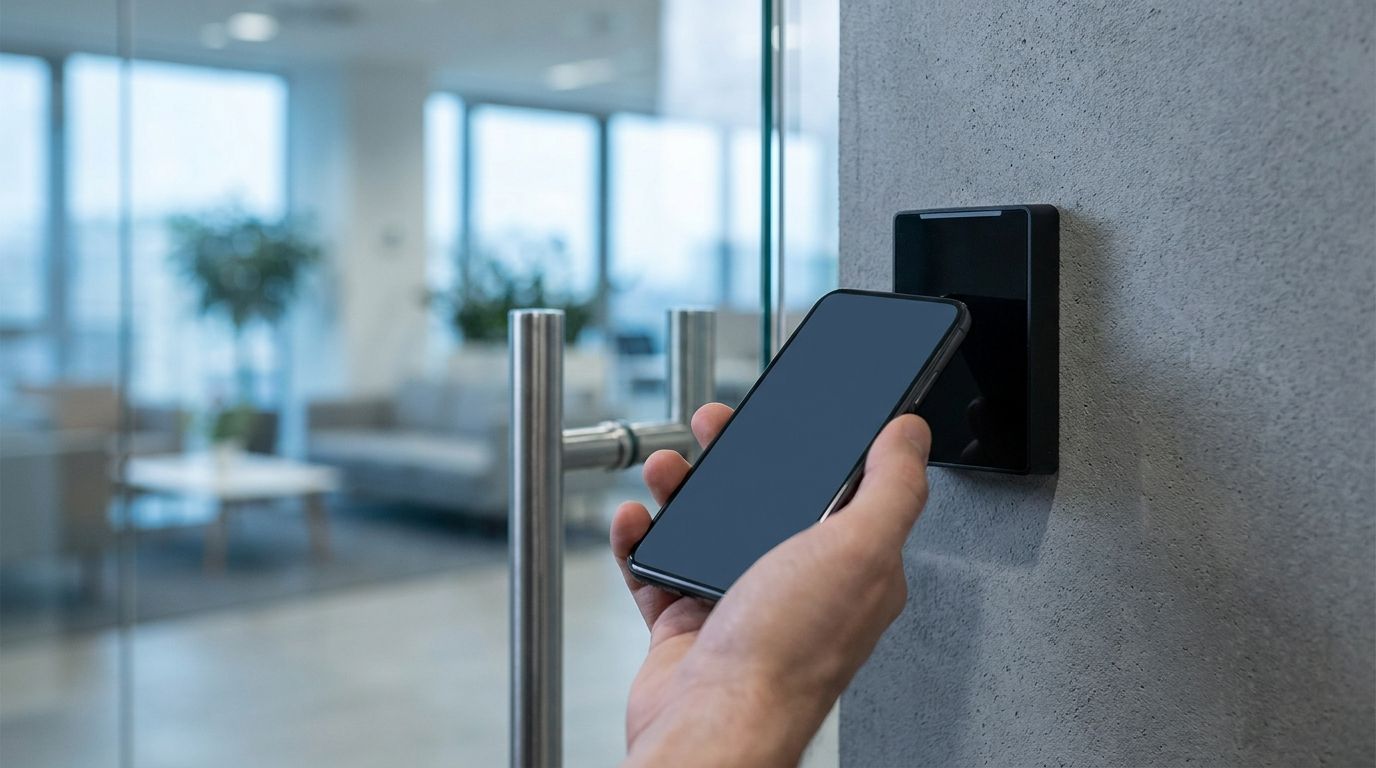
Access control is where security, life safety and daily convenience meet at a door — and all three have to work. A system that locks people out of their own suite gets propped open with a garbage can within a week; a system wired wrong at an egress door is a code violation waiting for a fire inspection to find it. Low Voltage New York scopes commercial access control projects across the state and matches them with licensed partner crews who install Division 28 systems for a living: readers, controllers, electrified hardware, intercoms and the platforms that tie them together.
The projects range from a four-door professional office to multi-tenant buildings where base-building access, elevator dispatch and per-tenant suite systems all have to coexist. Credential strategy is part of the design conversation, not an afterthought — proximity cards, smart cards, PIN, and increasingly mobile credentials on employees' phones, which eliminate badge replacement cycles and work well for distributed teams. We're platform-agnostic across the major cloud and on-premise systems, and we'll recommend based on your building count, IT posture and who actually administers the system day to day.
Every quote covers the full stack: door hardware and locking devices, reader and controller installation, power supplies, cabling back to the head-end, software configuration, and training for the person who has to add a new hire's credential on Monday morning.
Access control systems and hardware we install
The visible parts of access control — the reader on the wall, the app on a phone — sit on top of hardware choices that determine whether the system is reliable for a decade or a callback generator. Partner crews spec and install the whole chain, and they're fluent in the retrofit reality of New York building stock: doors that are older than the technicians, frames that need electrified hinges rather than new cores, and risers with no spare conduit.
- Readers — proximity, smart card, keypad, biometric and mobile-credential (BLE/NFC)
- Electrified hardware — strikes, maglocks, electrified levers and exit devices, matched to each door's construction and egress requirements
- Controllers and power — panel-based or edge controllers, supervised power supplies with battery backup
- Video intercoms — visitor entry at lobbies, loading docks and gates, with release from desk or phone
- Integration — elevator access, alarm arming, camera call-up on events, and visitor management
Multi-tenant buildings and enterprise portfolios
Multi-tenant access control is a design problem before it's an installation problem: base-building perimeter and elevator access owned by the landlord, suite-level systems owned by tenants, and a credential experience that doesn't force anyone to carry three badges. Partner crews build both sides — landlord systems with per-tenant partitioning, and tenant systems that ride cleanly on base-building infrastructure — and we're comfortable working under the property manager's rules, COI requirements and after-hours windows.
For businesses with multiple locations, cloud platforms have changed the economics: one administrator can manage doors in Buffalo, Albany and Brooklyn from a single pane, and adding a site is an enrollment rather than a server build. We'll be candid about where cloud subscription costs overtake on-prem over time, because the right answer depends on your door count and horizon.
Door hardware, egress and code
Every controlled door is still an egress door, and that's where amateur installs get buildings in trouble. Free egress has to be preserved — people must always be able to exit without a credential — and locking arrangements like maglocks carry specific code requirements for release devices, fire alarm interconnection, and signage. Fail-safe versus fail-secure isn't a preference, it's a per-door decision driven by the door's role in the egress path and fire strategy, and stairwell re-entry rules add another layer in high-rise buildings.
Partner crews install to the applicable building and fire codes, coordinate fire alarm tie-ins with the alarm vendor, and leave documentation showing each door's configuration — the thing your fire inspector and your insurance carrier both eventually ask for.
Projects to include in your scope
- Office and suite access control build-outs
- Multi-tenant base-building systems
- Legacy system takeovers and upgrades
- Intercom and visitor entry projects
FAQ
Access Control Systems — Common Questions
What does commercial access control cost per door?
Per-door cost swings widely with hardware choice: a reader plus electric strike on a cooperative door is the low end, while a door needing an electrified exit device, a new frame or maglock-with-release engineering costs multiples more. Head-end, software licensing and credentials add project-level costs that amortize better across more doors. We quote per-door line items from a door-by-door survey, so you can phase the rollout by priority if budget requires.
What's the difference between a door access system and a full access control system?
A door access system typically refers to a single-door solution — often a standalone keypad, card reader, or intercom-controlled electric strike. A full access control system is networked: multiple doors report to a central controller and management software, enabling features like credential-level permissions, scheduling (unlock during business hours, require badge after hours), audit trails, anti-passback (preventing badge sharing), and integration with video, intrusion and visitor management. For a single exterior door, a door access system may suffice. For multi-door buildings, tenant suites or campus environments, a networked access control system is the right investment.
Should we use key cards, fobs, or mobile credentials?
Key cards (prox or smart card) remain the most cost-effective credential for high-volume deployments — readers are cheap, cards are under $5 each, and the technology is universally supported. Mobile credentials (Bluetooth/NFC via smartphone) are gaining traction for tenant-facing buildings because they eliminate card management and enable remote provisioning, but reader costs are 2-3x higher and not all tenants' phones are compatible. Fobs are a middle ground. For most New York commercial buildings, we recommend a platform that supports both card and mobile credentials simultaneously, so you can phase the transition without replacing hardware.
Cloud or on-premise — which access control platform should I choose?
Cloud platforms win for multi-site portfolios, lean IT teams and anyone who values managing credentials from a browser without maintaining a server; the tradeoff is a recurring subscription per door or per site. On-prem still makes sense for single large facilities with capable IT and for organizations with strict data-residency policies. We install both and will model the five-year cost honestly for your door count before you commit.
Can you take over or upgrade an existing access control system?
Usually, yes. Many takeovers reuse existing door cabling and sometimes electrified hardware, replacing controllers and software — which preserves most of the original investment. The survey tells us what's salvageable: cabling gets tested, hardware gets evaluated door by door, and proprietary legacy panels sometimes force a bigger swap than hoped. You get the reuse-versus-replace math in the estimate, not after demolition.
Are mobile credentials reliable enough to replace cards?
For most commercial deployments, yes — modern BLE/NFC readers unlock reliably, employees rarely forget their phones, and revoking a departed employee's access is instant. Plan for edge cases: visitors, shared credentials for cleaning crews, and staff without company phones usually justify keeping a card or PIN option alongside. New readers we install are typically multi-technology, so running both costs nothing extra at the door.
Does access control work require permits or inspections in New York?
It can — particularly where locking hardware affects egress doors, ties into the fire alarm system, or involves maglocks and delayed-egress arrangements, which many jurisdictions review. New York City has its own filing requirements depending on scope, and fire alarm interconnections involve the alarm system's permit trail. Our partner crews are licensed in their jurisdictions and fold the required filings into the project schedule rather than treating them as surprises.
How do I choose an access control system installer in New York?
When evaluating access control system installers, look for: experience with your platform of choice (Genetec, LenelS2, Brivo, Verkada, AMAG), familiarity with NYC building code and FDNY requirements for electrified hardware, manufacturer certifications, and references from similar building types (office, multifamily, warehouse). Avoid companies that only do residential smart locks — commercial access control requires knowledge of egress codes, fire alarm integration, fail-safe vs fail-secure hardware, and ADA requirements. A qualified access control system installer will survey your doors, ask about your credential strategy, and design the system around how your building actually operates.
Pricing a access control systems project?
Share your building location, scope and timing. We will match your commercial enquiry with the appropriate partner contractor.