PLENUM BLACK · Division 28 · New York City
Commercial Security Camera Installers in New York City
Serving Manhattan, Brooklyn, Queens, Bronx, Staten Island and every commercial corridor in New York City.
- IP cameras, PoE-powered
- VMS and NVR platforms
- Retention-based storage sizing
- Remote monitoring readiness
- Coax-to-IP takeovers
- Commercial properties only
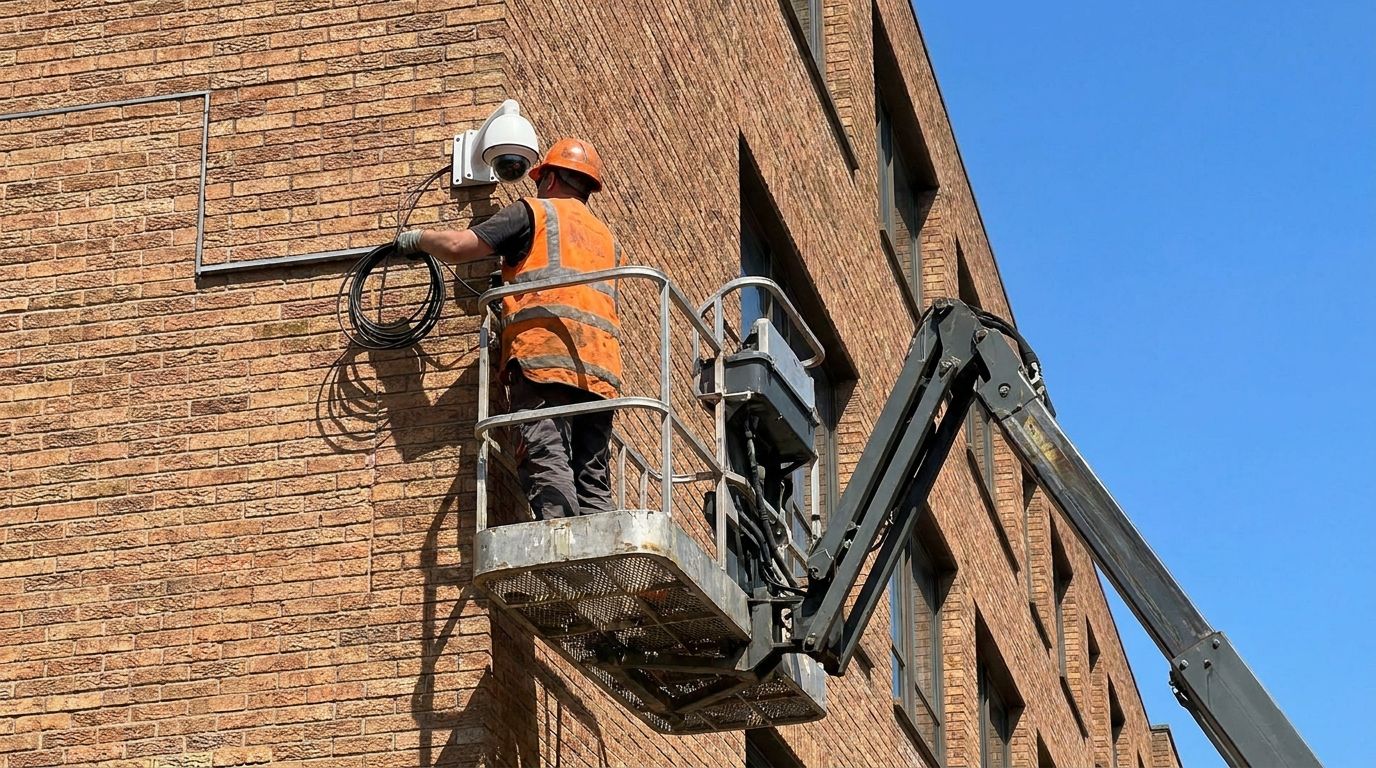
Camera projects in New York City are exercises in coverage economics: every entrance, loading dock, stairwell and service corridor is a potential liability scene, and property managers need footage that holds up — timestamped, retained to policy, and sharp enough to identify a face or a license plate at the distance that matters. Our partner crews design NYC systems around those failure points, spec'ing resolution and lens per camera position instead of scattering identical domes and hoping.
Installation in the city brings its own constraints. Exterior cameras on Manhattan and Brooklyn facades may involve landlord approvals and mounting rules; interior runs in older buildings need the same pathway creativity as any NYC cabling job; and multi-tenant properties need camera placement that respects lease lines while still covering common areas. We handle the approvals conversation during scoping and deliver systems on modern VMS platforms your security desk or property team can actually operate.
Commercial Security Cameras where you are
For NYC portfolio owners and property managers, cameras are increasingly a multi-building play: one VMS platform, standardized hardware, and footage from a Chelsea property and a Long Island City property reviewed from the same screen. Our network installs to that standard — consistent mounting, naming and retention across sites — so incident response doesn't depend on remembering which building runs which system.
Commercial locations in this region include Midtown and Hudson Yards office core, Financial District and World Trade Center campus, Downtown Brooklyn and the Brooklyn Navy Yard. Confirm the site address, building access and contractor availability when planning the schedule.
What the work includes
Camera counts don't equal coverage. A design pass walks your property against the incidents you're actually trying to resolve — vehicle damage claims, dock disputes, slip-and-fall defense, after-hours entry — and places cameras for identification where it matters and situational awareness everywhere else. Pixel density, mounting height, lighting conditions and lens choice all get engineered, because a camera that captures a hooded silhouette at 40 feet resolves nothing and costs the same to install as one that works.
Exterior work gets the same rigor: appropriate housings for New York winters, corrosion-resistant mounting, conduit where cable is exposed, and surge protection on runs that leave the building envelope.
- Fixed dome, bullet, turret and multi-sensor panoramic cameras, matched to each view
- License plate capture at gates and drive lanes, engineered as its own use case
- Low-light and IR planning for lots, docks and perimeters
- PoE infrastructure — switching, cabling and midspans sized with power budget headroom
Related
More in New York City
All services in New York City
Every low voltage trade we cover in the region
Commercial Security Cameras statewide
Full scope, standards, and FAQs for this service
Get a Free Estimate
Share the building, scope and target date
Security camera installation cost in NY
Per-camera and full-system ranges, cloud vs NVR
Access control systems
Doors, credentials and video call-up integration
Access control cost guide
Per-door tiers and NYC egress hardware rules
FAQ
Commercial Security Cameras in New York City — Questions
How long should an NYC commercial building retain camera footage?
Thirty days is the common baseline for commercial properties, with some owners and insurers specifying more for entrances and loading docks. Retention is a storage-sizing decision — we calculate it per camera count, resolution and frame rate during design so the NVR or cloud plan actually delivers the days you're promising your insurer.
Can you install cameras in an occupied office building without disrupting tenants?
Yes — that's standard NYC practice. Common-area and exterior work is scheduled through building management, cable runs use after-hours windows where required, and per-floor work is sequenced so no tenant loses elevator lobby or corridor access during business hours.
What's the difference between CCTV and IP camera systems?
CCTV (Closed-Circuit Television) traditionally refers to analog camera systems that transmit video over coaxial cable to a DVR. IP cameras are network devices that transmit digital video over Ethernet (Cat6) to an NVR or VMS server. In practice, the term 'CCTV' is now used loosely to describe all video surveillance systems, including modern IP-based ones. For new installations in New York commercial buildings, IP cameras are the standard: higher resolution (4MP-8MP vs. analog's 960H), Power-over-Ethernet (one cable for power and data), scalable storage, remote access, and AI analytics. We install IP camera systems exclusively for new deployments, but can integrate or migrate existing coax-based CCTV.
How many cameras does a typical business need?
Camera count depends on building size, layout, risk profile and coverage goals. A small office (2,000-5,000 sq ft) typically needs 4-8 cameras covering entrances, exits, and high-value areas. A warehouse (10,000-50,000 sq ft) may need 12-24 cameras for perimeter, loading docks, aisles, and common areas. Retail locations prioritize POS coverage and entrance/exit. We design coverage maps during the site survey — placing cameras to eliminate blind spots while minimizing camera count. Over-cameraing is a common waste; the right lens selection and placement often achieves better coverage with fewer cameras.
Need cameras in New York City?
Share your building location, scope and timing. We will match your commercial enquiry with the appropriate partner contractor.