SINGLE-MODE YELLOW · Division 27 · Long Island
Data Center Cabling Contractors on Long Island
Serving Hempstead, Melville, Hauppauge, Farmingdale, Garden City and every commercial corridor in Long Island.
- White space build-outs
- MPO/MTP fiber trunks
- Ladder rack + fiber runner
- Hot/cold aisle awareness
- Live migration MOPs
- Cabinet-level labeling
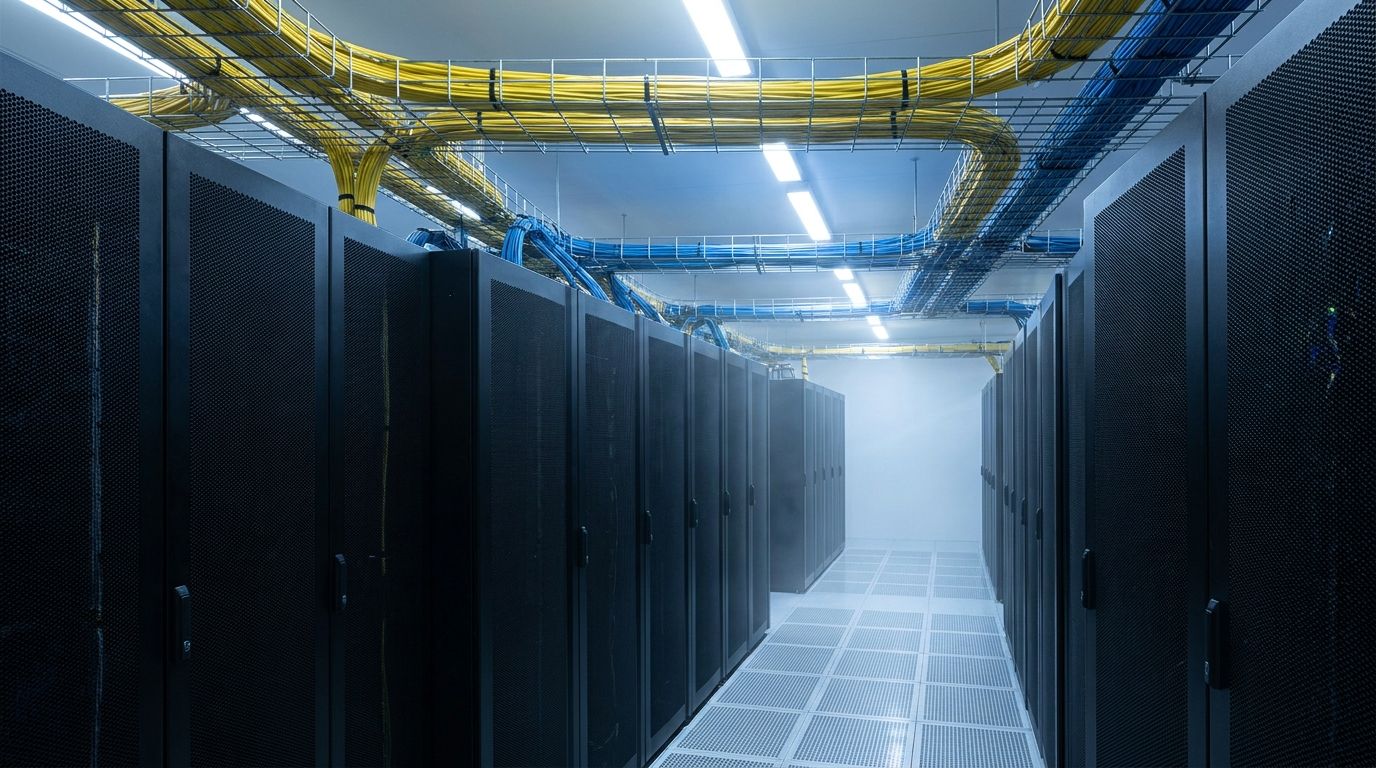
On Long Island, data center cabling mostly means the on-premises server room done right. The Island's healthcare networks, financial and professional firms, manufacturers and school-adjacent enterprises still run substantial in-house compute — and the rooms housing it are frequently a decade past their last honest cleanup, with abandoned cable choking the trays and patching that no diagram describes. Our partner crews rebuild those rooms: structured fiber and copper trunks, real cable management, and labeling that matches documentation delivered at closeout.
New-build server rooms and small data halls follow the same discipline from a cleaner starting point. We cable to a rack elevation plan, install overhead pathway sized for growth rather than for day one, run fiber trunks between core and distribution racks, and certify every link. For Island companies expanding compute for imaging, design or production workloads, the cabling plant gets engineered against the switch architecture — not improvised patch by patch as gear arrives.
Data Center Cabling where you are
The signature Long Island engagement is the live-environment rebuild: a Nassau or Suffolk company whose server room grew organically for fifteen years and now can't trace its own connections. Crews remediate these rooms in staged windows — mapping every live circuit first, then migrating connections to new structured trunks rack by rack, usually overnight or over weekends — because the medical group or manufacturer upstairs can't tolerate an outage while the room gets civilized.
Commercial locations in this region include Hauppauge industrial area, Route 110 corridor: Melville and Farmingdale, Garden City and Mineola office areas. Confirm the site address, building access and contractor availability when planning the schedule.
What the work includes
On a new room or cage, partner crews install the physical layer in dependency order: overhead ladder rack and fiber runner first, then trunk cabling between rows, then cabinet-level patching infrastructure, so the room is never blocked on cabling. Copper is Cat6A as a rule — at data center distances and densities, Cat6 buys almost nothing — and inter-row links are fiber trunks sized with growth headroom, because adding strands later means working over live racks.
We coordinate directly with your electrical and mechanical contractors on pathway routing, so low-voltage doesn't end up fighting power whips and duct for the same overhead corridor after the fact.
- Ladder rack, fiber runner and under-floor pathway installation
- Cat6A copper trunks and patching between cabinets and rows
- MPO/MTP backbone trunks with polarity managed end to end
- Meet-me room and carrier entrance connectivity
- Grounding and bonding of racks and pathway to the room's grounding grid
FAQ
Data Center Cabling in Long Island — Questions
Can you clean up a live server room without taking our systems down?
Staged remediation may reduce disruption, but the contractor and your IT team need to map active connections and identify dependencies first. Agree to maintenance windows, system-by-system cutover steps, validation and rollback procedures. Confirm any expected downtime for the Long Island server room before authorizing changes.
We're building a new server room in our Long Island facility. When should cabling get involved?
Bring cabling into the Long Island server-room design alongside electrical and cooling decisions. Rack layout, pathways and trunk sizing affect power and airflow coordination. Send the rack elevations, network architecture and planned equipment so the free estimate can identify cabling responsibilities, quantities and any design information still needed.
What standards govern data center cabling?
Data center cabling follows TIA-942 (Telecommunications Infrastructure Standard for Data Centers), which defines reliability tiers, pathway separation, redundancy and cable management requirements. Within that framework, individual links comply with TIA-568 for copper and TIA-568.3-D for fiber. Most colocation facilities layer their own standards on top — MPO polarity schemes, specific cable colors, containment routing rules, and work windows. We design and install to whichever combination of standards your facility enforces, and document compliance in the closeout package.
What's included in data center cabling design?
Data center cabling design covers the full physical layer plan: switch-to-server port mapping, top-of-rack vs. end-of-row architecture decisions, fiber trunk sizing (MPO/MTP for 40/100G, LC duplex for 10G), copper drop counts for management networks, pathway planning (overhead tray vs. under-floor), cable containment and airflow management, patch panel schedules, and labeling schemes. Good design prevents the two most common data center cabling failures: blocked airflow from oversized bundles and untraceable connections when a link goes dark at 2 AM.
Need data center in Long Island?
Tell us the site, systems needed and target date. We help clarify your commercial scope and match a partner contractor. Requesting an estimate is free, with no obligation to hire.