SINGLE-MODE YELLOW · Division 27 · Western New York
Data Center Cabling Contractors in Western New York
Serving Buffalo, Rochester, Niagara Falls, Amherst, Cheektowaga and every commercial corridor in Western New York.
- White space build-outs
- MPO/MTP fiber trunks
- Ladder rack + fiber runner
- Hot/cold aisle awareness
- Live migration MOPs
- Cabinet-level labeling
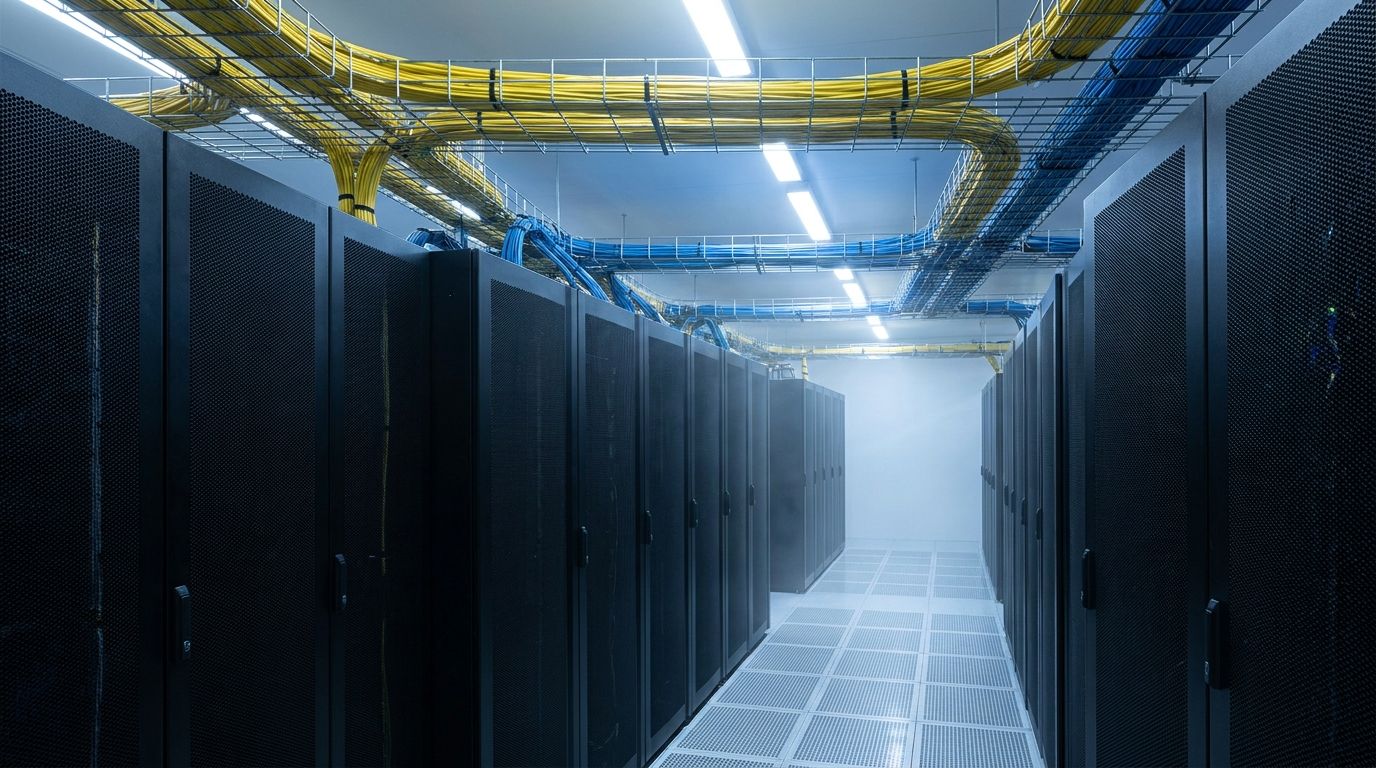
Western New York has quietly become one of the state's most serious data center markets, and the reason is power. TeraWulf's Lake Mariner campus in Barker — designed for 750 MW of AI and HPC capacity, with financial backing from Google — draws on hydropower allocations that make Niagara-frontier megawatts some of the cheapest and cleanest available for compute, and the cool climate helps the thermal math too. Around anchor projects like that sits a widening layer of operators, integrators and service firms who need their own racks cabled to a matching standard.
The region's institutional demand is just as real. The Buffalo Niagara Medical Campus and the hospital networks around it generate imaging archives, research datasets and clinical systems that live in on-premises data rooms, while Rochester's manufacturers and optics firms run compute tied directly to production. Our Western NY partner crews build the cabling layer for all of it — MTP/MPO fiber trunks, structured copper within cabinets, overhead pathway sized for growth, and OTDR and Fluke certification on every link at closeout.
Data Center Cabling where you are
High-density AI and HPC halls are changing what data center cabling in Buffalo actually means. Liquid-cooled rows, 400G optics and fiber counts an office building never sees demand tighter polarity planning, cleaner slack management and documentation a facility operator will genuinely audit. Crews in our network who work hyperscale-adjacent sites carry that discipline back to the enterprise data rooms of Buffalo and Rochester, where it costs nothing extra to do it right.
Commercial locations in this region include Buffalo Niagara Medical Campus, Eastman Business Park (Rochester), RiverBend / South Buffalo advanced-manufacturing district. Confirm the site address, building access and contractor availability when planning the schedule.
What the work includes
On a new room or cage, partner crews install the physical layer in dependency order: overhead ladder rack and fiber runner first, then trunk cabling between rows, then cabinet-level patching infrastructure, so the room is never blocked on cabling. Copper is Cat6A as a rule — at data center distances and densities, Cat6 buys almost nothing — and inter-row links are fiber trunks sized with growth headroom, because adding strands later means working over live racks.
We coordinate directly with your electrical and mechanical contractors on pathway routing, so low-voltage doesn't end up fighting power whips and duct for the same overhead corridor after the fact.
- Ladder rack, fiber runner and under-floor pathway installation
- Cat6A copper trunks and patching between cabinets and rows
- MPO/MTP backbone trunks with polarity managed end to end
- Meet-me room and carrier entrance connectivity
- Grounding and bonding of racks and pathway to the room's grounding grid
FAQ
Data Center Cabling in Western New York — Questions
Can your crews handle high-density fiber work for AI or HPC hosting environments near Buffalo?
Yes. High-density environments mean pre-terminated MTP/MPO trunk architecture, polarity and port maps engineered before a single cassette ships, and test documentation matched to the facility's standards. We assign Western NY crews with data hall experience to those scopes and coordinate every work window with facility operations.
Our Buffalo medical facility is expanding its imaging storage. Can you cable the data room?
Yes — hospital data rooms are a steady Western NY project type. The work runs under clinical facility protocols: scheduled access, containment where the room borders occupied space, and staged cutovers so PACS and clinical systems stay reachable while new trunks and cabinets come online.
What standards govern data center cabling?
Data center cabling follows TIA-942 (Telecommunications Infrastructure Standard for Data Centers), which defines reliability tiers, pathway separation, redundancy and cable management requirements. Within that framework, individual links comply with TIA-568 for copper and TIA-568.3-D for fiber. Most colocation facilities layer their own standards on top — MPO polarity schemes, specific cable colors, containment routing rules, and work windows. We design and install to whichever combination of standards your facility enforces, and document compliance in the closeout package.
What's included in data center cabling design?
Data center cabling design covers the full physical layer plan: switch-to-server port mapping, top-of-rack vs. end-of-row architecture decisions, fiber trunk sizing (MPO/MTP for 40/100G, LC duplex for 10G), copper drop counts for management networks, pathway planning (overhead tray vs. under-floor), cable containment and airflow management, patch panel schedules, and labeling schemes. Good design prevents the two most common data center cabling failures: blocked airflow from oversized bundles and untraceable connections when a link goes dark at 2 AM.
Need data center in Western New York?
Share your building location, scope and timing. We will match your commercial enquiry with the appropriate partner contractor.