FIBER ORANGE · Division 27 · Long Island
Commercial Fiber Optic Cabling on Long Island
Backbone, riser and building-to-building fiber in Nassau and Suffolk. Share the endpoints, pathway and timing so we can scope your project and match a suitable partner contractor.
- MDF-to-IDF backbone
- Building-to-building links
- Carrier handoff extensions
- Splicing and termination
- Optics and fiber compatibility
- Loss-test documentation
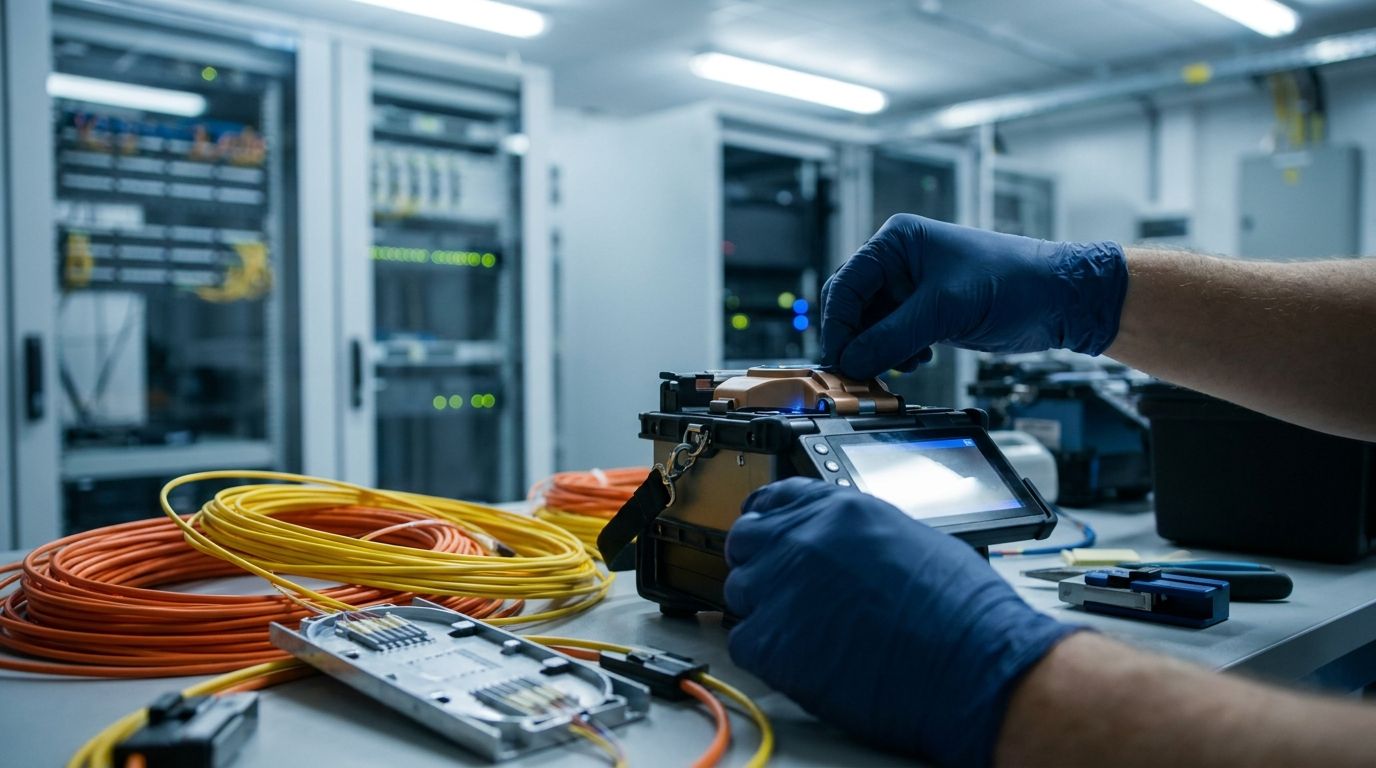
For commercial fiber optic installation on Long Island, identify what the link must connect: a carrier handoff to your equipment room, an MDF-to-IDF riser, or two separate buildings. A Nassau office fit-out may need an internal extension and managed-building access. A Suffolk industrial property may also need a surveyed outdoor route, entrance transitions and an assigned civil-work contractor.
Low Voltage New York is a network of licensed, insured partner contractors. We use your project information to scope the requested work and match a suitable crew. Ask for separate allowances for the pathway, cable, termination, testing and cutover so you can compare what each proposal actually includes.
Fiber Optic Cabling where you are
New York State announced the groundbreaking for Orbic's planned Hauppauge electronics facility on June 4, 2025. That dated announcement provides local manufacturing context; it does not establish the facility's current construction status. For a Long Island production or warehouse site, identify the equipment rooms and operational areas the proposed backbone will serve before choosing a cable. Institutional and multi-building projects around Northport also need a documented route and ownership boundary for each building connection.
Commercial locations in this region include Hauppauge industrial area, Route 110 corridor: Melville and Farmingdale, Garden City and Mineola office areas. Confirm the site address, building access and contractor availability when planning the schedule.
What the work includes
Treat the optical link and its pathway as separate decisions. Existing conduit may need inspection before it can be included in a bid; a new route needs an explicit owner for excavation, permissions, restoration and entrance work. Confirm those responsibilities with the property team and proposed contractors before scheduling a pull.
- Endpoints: building, equipment room, rack and patch-panel location at both ends.
- Pathway: measured route, available sleeves or conduit, entry points and access restrictions.
- Cable and optics: fiber type, strand count, connectors and the actual switch/transceiver requirements.
- Termination: splice or pre-terminated assembly plan, patch panels and labeling.
- Handover: required tests, acceptance limits, route drawings and a named owner for cutover.
Carrier handoff or private building network?
A business internet order and a premises fiber installation have different responsibility boundaries. Ask the carrier to identify its demarcation point and included work, then establish who extends the connection to your equipment room. For a private link between buildings in Nassau or Suffolk, identify the property owner, network owner and any route crossing a third party's land. Don't assume a cabling quote includes an internet circuit or carrier activation.
- Existing circuit: carrier, handoff location and interface, with activation or change dates if known.
- Private backbone: both building endpoints, route ownership and the IT team responsible for equipment configuration.
Assign the handoffs before the site visit
For an occupied Long Island office, warehouse or campus, identify who can approve the route and who can authorize a network outage. Put those responsibilities in the scope rather than assuming one installer controls every dependency.
- Carrier: circuit order, agreed handoff and activation coordination.
- Facilities or landlord: pathway access, entrances, restoration and any required approvals.
- Cabling contractor: agreed materials, installation, labels and test reports.
- IT team or integrator: compatible optics, configuration, service checks and cutover or rollback approval.
Agree on tests and cutover before installation
Specify insertion-loss testing with a light source and power meter or an optical loss test set, using the agreed wavelengths, reference method and acceptance limits. OTDR traces characterize events along the fiber and can help locate faults; they do not replace insertion-loss acceptance. Select the test set for the design, existing plant and applicable warranty requirements.
Before moving traffic, agree who patches the link, configures the active equipment, checks the required services and authorizes a rollback. A cable test and a successful application cutover are separate acceptance steps.
- Match each result to its physical strand and endpoint labels.
- Record failures, corrective work and retest results before acceptance.
- Retain the route, splice and patching records with the final test reports.
FAQ
Fiber Optic Cabling in Long Island — Questions
Can you scope fiber between two commercial buildings on Long Island?
Share both building locations and the intended network use. A proposed route needs review of property ownership, available conduit, entrances, access and any civil work. Contractor availability, permissions and the division of work are confirmed during scoping; owning both buildings does not settle every route requirement.
Should our Nassau or Suffolk site use single-mode or multimode fiber?
Compare the measured distance, required link speed, existing fiber, connector losses and supported transceivers. Both fiber and optics have limits. Single-mode can suit longer building links, while compatible multimode may suit an existing short backbone; select the actual equipment and loss budget together.
Does this service include buying business internet?
This page covers commercial cabling and related installation scope. Confirm internet service, the carrier's handoff and activation separately. Tell us if you need a demarcation-point extension so the proposal identifies the boundary between carrier work and your building network.
What determines the estimate for a Long Island fiber installation?
Route condition, access, cable and strand selection, termination, testing and service interruption requirements shape the scope. Separate new excavation or conduit from using an existing pathway. Get a Free Estimate with the site town, endpoints and timing; a site-specific proposal is more useful than a generic per-foot price.
Project planning
Planning resources
Fiber installation planning guide
Review the broader bid and acceptance checklist before comparing proposals.
Fluke: insertion loss and OTDR
Primary technical guidance on the different purposes of these fiber tests.
Hauppauge manufacturing context
New York State's June 4, 2025 Orbic announcement; a dated local source, not a current project-status report.
Need fiber in Long Island?
Share your building location, scope and timing. We will match your commercial enquiry with the appropriate partner contractor.