FIBER ORANGE · Division 27 · Western New York
Fiber Optic Cabling Contractors in Western New York
Serving Buffalo, Rochester, Niagara Falls, Amherst, Cheektowaga and every commercial corridor in Western New York.
- Fusion splicing
- OM3 / OM4 / OM5 multimode
- OS2 single-mode
- Backbone and riser runs
- Campus and OSP fiber
- OTDR + insertion loss testing
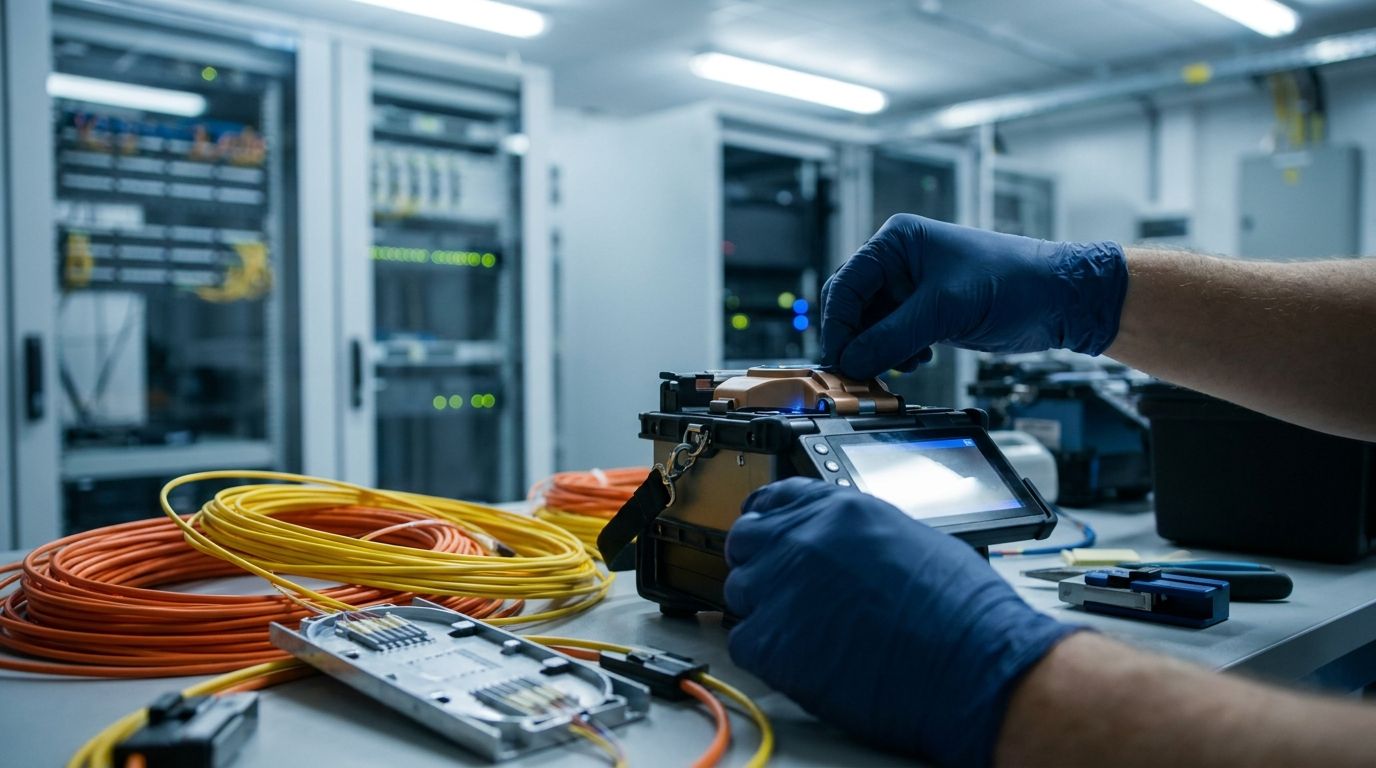
Rochester arguably has more fiber optics heritage per square mile than any city in America — the region's optics and photonics industry grew up alongside its universities and imaging giants — and Western New York's commercial fiber demand reflects that technical depth. Manufacturers linking plant buildings across a site, hospital systems tying campuses together, and the industrial acreage of legacy parks like Eastman Business Park all generate serious fiber scopes: multi-building backbones, long outside-plant runs, and strand counts sized for industrial data loads.
Distance and weather shape the engineering. Campus and inter-building links in Buffalo and Rochester routinely exceed what copper can carry, making single-mode fiber the default; outside-plant segments — aerial, direct-buried or in conduit — have to be specified for freeze-thaw ground movement, ice loading and the moisture that finds every unsealed enclosure. Our Western NY partner crews build OSP and premise fiber to those conditions, fusion-splice in place, and OTDR-certify every strand end to end.
Fiber Optic Cabling where you are
The multi-building industrial site is Western New York's defining fiber project. A manufacturer with production in one building, warehousing in another and offices in a third needs a fiber backbone tying the operation together — often across yards, rail spurs or roadways that dictate buried or aerial routes. Our crews scope the civil reality alongside the optical design: pathway, permits where crossings require them, entrance points, and splice locations planned so future buildings can join the ring without rebuilding it.
Commercial locations in this region include Buffalo Niagara Medical Campus, Eastman Business Park (Rochester), RiverBend / South Buffalo advanced-manufacturing district. Confirm the site address, building access and contractor availability when planning the schedule.
What the work includes
Vertical backbone is the classic case: multi-strand trunks from the MDF up through the riser to each floor's IDF, sized with spare strands because pulling fiber twice costs more than pulling extra once. For campuses — hospitals, schools, industrial sites, multi-building offices — partner crews run single-mode between buildings through existing duct banks or new conduit, handling the wet-to-dry transition, grounding of armored cable, and slack loops at each end.
Single-mode is the default for any new backbone or campus run: the cable itself is cheap, distance limits effectively disappear, and it won't be the reason you re-cable in ten years. Multimode still makes sense inside data rooms and for short runs where existing optics dictate it — we'll match what your switching hardware actually needs.
- Riser backbone trunks, MDF to IDF, with spare-strand planning
- Campus and building-to-building runs in conduit, duct bank or aerial
- Entrance facility transitions, grounding and slack management
- Armored, indoor/outdoor and plenum-rated cable selection to match the pathway
FAQ
Fiber Optic Cabling in Western New York — Questions
Can you run fiber between buildings across our plant site near Buffalo?
Yes — inter-building OSP fiber is a core Western NY project type. The site walk determines the route options (buried, conduit or aerial), the design sets strand counts and splice points with expansion in mind, and installation is specified for the region's freeze-thaw cycles and ice loads. Every strand is OTDR-tested at completion.
Our Rochester facility needs a fiber upgrade but production can't stop. How is that handled?
New backbone gets built parallel to the old one. Crews install and fully certify the new fiber while your existing links keep carrying traffic, then cut services over in short, scheduled windows — typically off-shift — with the old path held as fallback until the new plant is proven.
How much does fiber optic cable installation cost?
Fiber installation cost depends on strand count, cable type (single-mode vs. multimode), pathway conditions (conduit vs. aerial vs. trenching), splice count, and connector type. Indoor riser backbone runs price per-strand differently than outdoor campus links requiring conduit and entrance facilities. Most New York fiber projects range from $3-12 per foot installed for standard indoor runs, with campus and OSP work varying widely by terrain and permitting. We scope your actual conditions and return a line-item estimate within 48 hours.
What drives the cost of a fiber optic cabling job?
Strand count, run length and pathway condition dominate. A 12-strand riser trunk through open sleeves is a quick job; the same trunk through packed cores that need boring, or a campus run requiring trenching and new conduit, is mostly a pathway project with fiber at the end of it. Splicing and testing scale with strand count. We break all of this out in the estimate so you can see where the money actually goes.
Need fiber in Western New York?
Share your building location, scope and timing. We will match your commercial enquiry with the appropriate partner contractor.