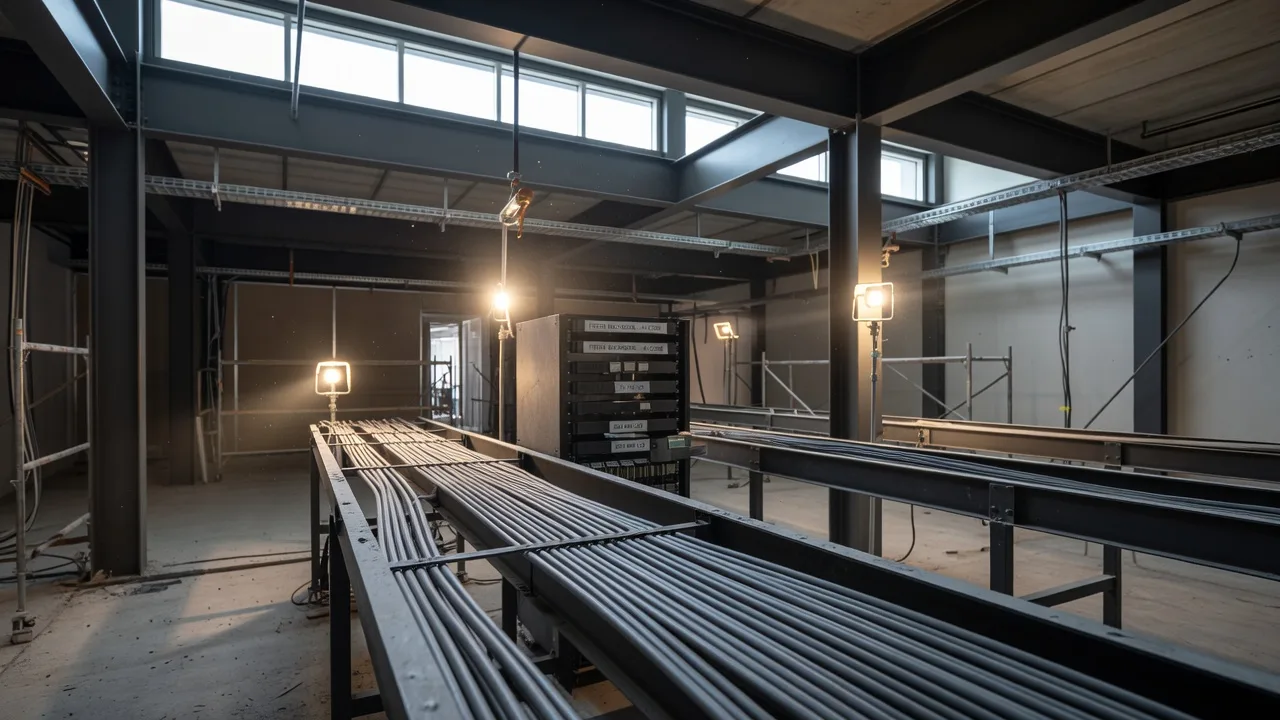
Blockfusion has locked a non-binding letter of intent with an unnamed AI customer for up to 300 megawatts of critical IT capacity at its flagship Niagara Falls campus — a deal anchored by 85 MW of guaranteed take-or-pay capacity and paired with a proposed $175 million convertible-note financing. The announcement, reported by Data Center Dynamics on July 7 and detailed in Blockfusion’s June 30 GlobeNewswire release with SPAC partner Blue Acquisition Corp., marks a concrete step in the company’s pivot from cryptocurrency mining to high-performance compute and AI infrastructure in Western New York. For low-voltage trades, a crypto-to-AI conversion at this scale is not a rack swap — it is a full campus rebuild of structured cabling, fiber backbone, and security systems.
What the LOI actually commits
The LOI is non-binding except for confidentiality, exclusivity, and governing-law provisions. Under the proposed terms reported by both DCD and the company:
- Up to 300 MW of total critical IT capacity at the Niagara Falls campus, subject to due diligence and definitive lease agreements for each tranche.
- 85 MW of guaranteed take-or-pay capacity, delivered in phases, with each phase carrying a 15-year firm initial lease term plus two five-year renewal options.
- Estimated revenue on the guaranteed slice alone of roughly $2.8 billion over the initial 15-year term, or about $5.4 billion if both renewal options are exercised — company estimates that assume the lease closes on LOI terms and full performance.
- $175 million private placement of convertible senior notes (non-binding term sheet), expected to fund at the closing of Blockfusion’s business combination with Blue Acquisition Corp. and to be anchored by funds managed or advised by Sona Asset Management.
- Land exclusivity covering additional parcels sized to support expansion beyond 300 MW of critical IT capacity over time, with advanced negotiations toward a purchase and sale agreement.
DCD notes that Blockfusion previously operated roughly 46 MW of Tier I capacity at Niagara Falls, with earlier plans to expand past 100 MW of Tier III capacity for AI computing. The LOI and financing package raise the ceiling well above those earlier targets — if definitive leases and the SPAC close land on the schedule management is pursuing.
This is not a signed lease and not closed capital. It is a public commitment of commercial and financing intent that, if converted, funds a multi-year build-out on a power-rich Western NY site.
Crypto racks to AI halls: why the low-voltage profile changes
Bitcoin mining and AI training share a building envelope and a power feed. They do not share cabling density, fiber topology, or security architecture. The same transition is visible across New York — at TeraWulf’s Lake Mariner facility and at NYDIG’s proposed Massena campus — and Niagara Falls is now part of that pattern.
High-density structured cabling. AI racks pull far more copper and fiber per cabinet than mining rigs. Delivering 85 MW of take-or-pay capacity in tranches means phased data center cabling packages: horizontal runs designed for high-density switches, trunk fiber between halls, meet-me-room connectivity, and labeling/test packages that support commissioning per phase. Crews in our network who hold BICSI certifications are the ones who scope and document this work before cabinets land.
Fiber backbone and carrier entrance. A campus aiming past 300 MW needs redundant outside-plant fiber to carrier backbones, diverse building entrances, and fusion-spliced pathways that survive construction phasing. Fiber-optic cabling at this scale is not a single-day pull — it is OSP design, manhole work, and indoor backbone that has to stay live while halls come online in sequence.
Security and access control across an expanding footprint. Take-or-pay AI customers expect multi-layer physical security: perimeter cameras, gate control, mantraps, and credentialed access control at hall, cage, and cabinet levels. Expanding onto newly secured land multiplies the commercial security camera and access-control scope beyond the existing footprint.
Phased delivery forces phased low-voltage packages. Guaranteed capacity arrives in tranches. That means structured cabling packages that can commission hall-by-hall without tearing out earlier work, temporary pathways during construction, and security zones that expand as new parcels come online.
Niagara Falls and the Western NY data center cluster
Niagara Falls sits on hydroelectric power and grid infrastructure that data center operators treat as scarce. Blockfusion’s COO, Kant Trivedi, framed the expansion as access to “highly strategic, power-rich locations with existing energy infrastructure.” That power position is what makes a 300 MW AI offtake commercially plausible in Western New York rather than only in Northern Virginia or Dallas.
For contractors and GCs already working the Buffalo–Niagara corridor, the LOI is a demand signal: if definitive leases close and convertible-note proceeds fund the initial build-out, Division 27 and Division 28 packages will compete with every other large project in the region for the same crews. Temporary construction offices, staging yards, and logistics buildings around the campus will need their own tenant fit-outs — structured cabling, Wi-Fi backbone, and site security — before the data halls themselves finish.
The project also sits inside the statewide large-load picture we track on the NYISO interconnection queue tracker. Western New York is already one of the state’s emerging data center clusters; an anchor AI lease at Niagara Falls is another data point that the cluster is moving from concept to contracted demand.
What still has to close
Several gates sit between LOI headlines and cable pulls:
- Definitive lease agreements for each capacity tranche, including design and work requirements the LOI flags as still to be negotiated.
- Business combination closing with Blue Acquisition Corp. — Form S-4 review, shareholder votes, and minimum-cash conditions.
- Convertible notes funding at closing, itself conditioned on the business combination, the anchor offtake lease, and expansion-site agreements.
- Land purchase converting the exclusivity agreement into owned parcels for the >300 MW pathway.
- Permits and interconnection for the expanded critical IT load.
Blockfusion CEO Alex Martini said the focus is completing S-4 review and closing the combination efficiently. Until those steps land, the low-voltage scope is real but not yet scheduled — which is exactly when IT directors, owners, and GCs should be defining standards packages rather than reacting to bid windows.
What it means for buyers and contractors
An AI offtake LOI at this size does not wait for perfect certainty to start design coordination. Owners who wait until definitive leases are public often find the best data center cabling and fiber crews already committed to other Western NY or statewide work. The practical move now is to map the phased capacity schedule against structured cabling, OSP fiber, and security packages so bid packages are ready when capital funds.
Partner contractors in our network who specialize in high-density cabling, fusion-spliced fiber, and multi-layer campus security can help scope Niagara Falls–class work before the schedule compresses. That is matching — not a claim that any single shop “owns” the campus.
Planning high-density structured cabling, fiber backbone, or campus security for a Western New York data center or industrial build? Get a free estimate — our network will route your package to a licensed partner crew that fits the density and schedule.