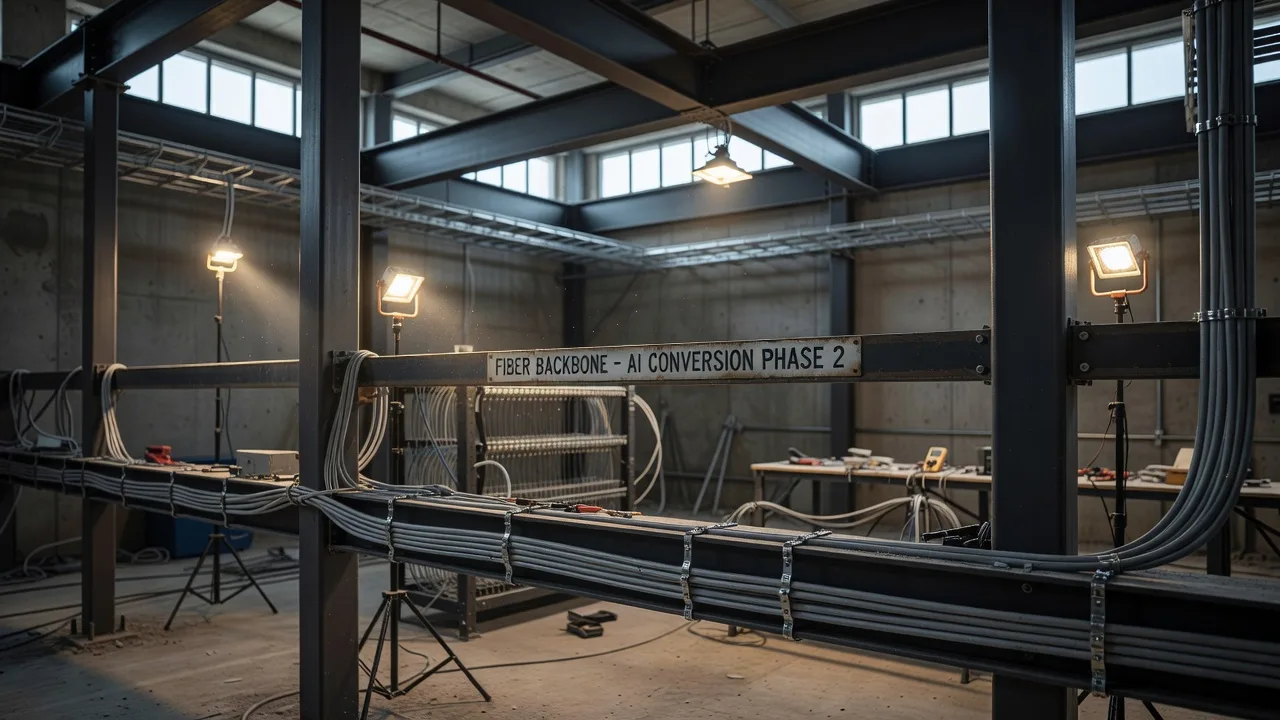
Executive Order 62 has a third act, and it is the one that actually produces near-term low-voltage work. Greenfield hyperscale is frozen at the state level for many 50 MW+ projects, and Long Island closed a local lane at Brookhaven. Developers are pivoting to conversions of already-powered sites — and the Finger Lakes’ most-fought-over plant is the clearest New York test case.
Greenidge Generation at 590 Plant Road in Dresden, on Seneca Lake, has rebranded as Vulcan Infrastructure and Power, raised nearly $40 million, and is seeking roughly 200 megawatts of additional grid power on top of its existing 107 MW bitcoin-mining footprint to turn the site toward an AI data center campus. WXXI (New York Public News Network) and The Real Deal both reported the pivot on July 30, 2026 — about two weeks after Governor Hochul signed the statewide pause.
For anyone scoping data-center cabling, fiber, or security in Western and Finger Lakes New York, the useful story is not the rebrand. It is what a crypto-to-AI conversion actually rebuilds — and where the DEC’s silence leaves the timeline.
What Vulcan is asking for
Per WXXI and TRD:
- The company formerly known as Greenidge is now trading and messaging as Vulcan Infrastructure and Power.
- It wants about 200 MW more from the grid — WXXI notes that is roughly enough for 150,000 homes on a simple residential comparison — stacked on a current mining operation rated around 107 MW.
- It says it has raised nearly $40 million tied to the effort.
- Vulcan’s public statement frames reliable power as the scarce input for AI infrastructure and positions the Dresden site as already powered.
- Company materials leave open whether crypto mining stops entirely; investors want the site developed as a data center.
- Last year the mining business reported $15.2 million in revenue, down 25 percent year over year — context for why an AI narrative is attractive.
Neither outlet reports a signed hyperscale lease or a completed change-of-use permit. This is a strategic pivot under active local and environmental scrutiny, not a commissioned hall.
The regulatory gray zone that matters operationally
EO 62 directs DEC discretionary permits for covered data centers to be held while the state studies impacts. The order’s live edge is the 50 MW threshold and the “construction or expansion” language — details we walked through in our EO 62 analysis.
On Vulcan specifically, DEC spokesperson Jeff Wernick told WXXI the department has not received any new applications relating to a reported change of use from crypto mining to data center operations. DEC also would not say whether Vulcan’s plans fall under the moratorium. Hochul’s office referred questions to DEC.
That gray zone is the single most useful fact for GCs and owners scoping New York data-center work right now. A powered-shell or retired-plant conversion may move on a different clock than a greenfield 50 MW+ project that still needs a fresh DEC discretionary permit — or it may not. Until DEC or the Governor’s office draws a bright line on change-of-use and incremental load at existing generators, every Dresden-class deal needs counsel and a written agency read, not a headline assumption.
Local opposition is not abstract. Seneca Lake Guardian and Earthjustice have spent years on Greenidge’s emissions, lake impacts, and tourism conflict. Earthjustice attorney Lisa Perfetto told WXXI the rebrand does not change the load and emissions profile; Yvonne Taylor of Seneca Lake Guardian said a new name does not erase the track record. Political risk is part of the critical path whether or not EO 62 formally captures the filing.
Crypto halls are not AI halls — the Division 27/28 delta
ASIC mining and GPU training can share a fence line and a substation. The copper counts, fiber topology, and security zoning do not transfer. The same pattern showed up at Blockfusion’s Niagara Falls AI LOI and in broader NY conversion talk: the building envelope is the easy part.
Structured cabling density. Mining halls are often sparse copper, minimal horizontal distribution, and ambient-cooled rows. GPU halls need data center cabling designed for high-radix switching, much higher port counts per rack, trunk fiber between halls, and test packages that support phased commissioning. Density jumps an order of magnitude; the old drops do not “get reused.”
Fiber backbone and meet-me design. AI campuses need real outside-plant diversity, building entrances, cross-connect / MMR layout, and fusion-spliced backbone that survives phased hall delivery. Fiber-optic cabling is a design package, not a weekend pull between miner cages.
Pathway, containment, grounding and bonding. Higher rack density forces redesigned tray, aisle containment coordination, and grounding-bonding that mining sheds rarely have documented to data-center commissioning standards.
Security and environmental monitoring mining never needed. Take-or-pay AI customers expect perimeter detection, gate control, mantraps, credentialed access control at hall and cage levels, commercial CCTV with retention suited to the risk profile, and environmental monitoring on the same IP plant. A 20,000-unit mining floor optimized for uptime of commodity ASICs is not that stack.
In short: crypto-to-AI is a full Division 27/28 rebuild, not a rack swap. Anyone bidding “reuse existing cabling” on a Dresden-class conversion is pricing a different building than the one AI tenants will accept.
Where this sits on the NY map
Dresden sits on Seneca Lake in the Finger Lakes. On our coverage grid, the nearest published town page is Geneva, inside the Western New York hub. The regional read matches other powered-site plays: Niagara Falls conversion pressure, Massena hydro expansion review, and the statewide large-load queue we track on the NY data center pipeline page.
EO 62 pauses a slice of new hyperscale permitting. It does not erase interconnection demand, and it does not stop every local or conversion path. Brookhaven showed municipalities will still slam their own brakes (Long Island moratorium). Vulcan shows operators will still chase already-powered shells while the GEIS clock runs.
For low-voltage trades, the near-term book of work concentrates where power and buildings already exist: enterprise retrofit, colo expansion, and conversion design packages that can go shovel-ready if and when agency clarity lands.
What to do if you touch conversion scope
- Get the EO 62 read in writing for the specific site — change of use, incremental MW, and whether any DEC discretionary permit is actually required.
- Separate power aspiration from cabling scope. A 200 MW grid ask is not a commissioned hall; price phased structured cabling packages against real hall delivery, not press-release MW.
- Design fiber and MMR as if the tenant is AI, not mining. Backbone, diversity, and cross-connect are the long-lead items.
- Rebuild security zones from the fence in. Perimeter, vehicle gates, mantraps, and cage-level access control are new scope on most mining footprints.
- Watch DEC guidance and local litigation as hard schedule gates — same class of risk as steel and switchgear.
Connecting to the right crews
LowVoltage-NewYork connects commercial owners, data-center developers, facility managers, and GCs with licensed partner crews across New York. If you are scoping a powered-shell or crypto-to-AI conversion — high-density copper and fiber, MMR design, access control, CCTV, or environmental monitoring — we match the package to a crew that has done dense infrastructure work, not just office drops.
Crews in our network hold BICSI credentials and the licensing the jurisdiction requires. Need a conversion cabling or security package quoted in the Finger Lakes or broader Western NY? Get a free estimate and we will route it.
Related pages: data-center cabling × Western NY, structured cabling × Western NY, Geneva, Western NY hub, NYISO pipeline tracker, and EO 62.